Who Beat Their xG at the 2022 World Cup — and Who Wasted It
Goals minus expected goals, team by team. The Netherlands and England ran hot; Belgium and Brazil went home wondering where the goals went.
Expected goals (xG) tells you how good a team's chances were; the scoreboard tells you what it did with them. The gap between the two — goals minus xG — is where finishing, hot streaks, and plain luck all live. Run every open-play shot from the 2022 World Cup through StatsBomb's xG model and a clear pattern falls out: the teams that went deep mostly beat their expected goals, while two of the tournament's biggest disappointments — Belgium and Brazil — wasted theirs. The Netherlands scored 10 open-play goals on just 5.0 xG; Belgium managed one goal on 3.7.
Sourcing. Every number is computed from StatsBomb's free, public 2022 World Cup data — all 64 matches, with a model xG attached to each shot. Penalties are excluded throughout (each is worth about 0.79 xG and would swamp the open-play picture). Nothing is from memory or invented.
The exhibit: goals vs. expected goals
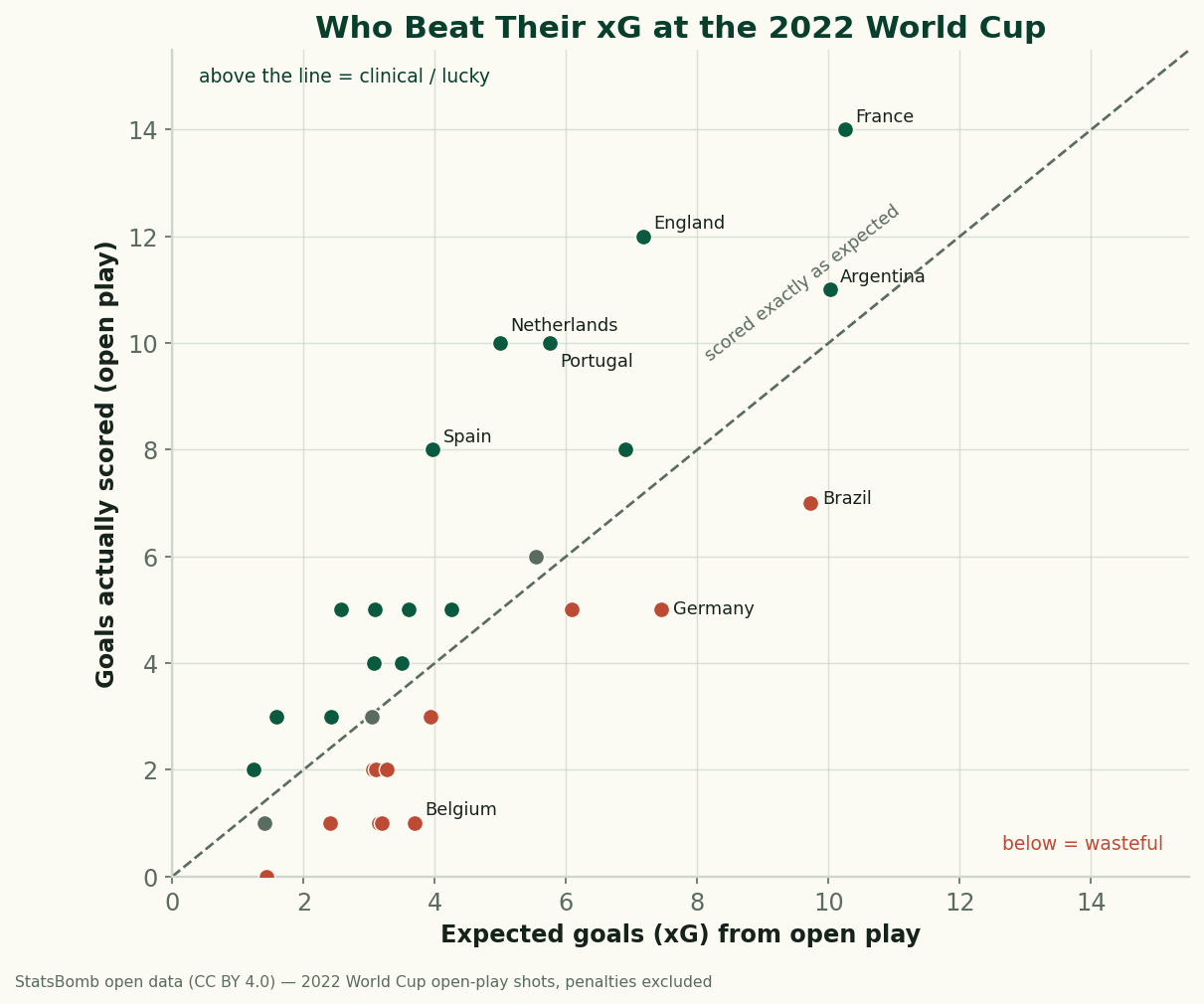
The diagonal is “you scored exactly what your chances were worth.” The story is in the distance from it. Up and to the left — clinical or hot — sit the Netherlands (+5.0), England (+4.8), Portugal (+4.3), Spain (+4.0) and France (+3.7). Down and to the right — wasteful or cold — sit Brazil (−2.7), Belgium (−2.7) and Germany (−2.4). Across the whole tournament, teams scored 152 open-play goals on 137.9 xG, so finishing ran a little hot overall — but the team-by-team spread is what matters.
The numbers that defined two campaigns
- Belgium: 1 goal on 3.7 xG (−2.7). The clearest epitaph for a golden generation's last World Cup. Belgium created enough to score three or four open-play goals and managed one. They went out in the group stage.
- Brazil: 7 goals on 9.7 xG (−2.7). The tournament's biggest chance-creator under-finished and then lost a quarter-final on penalties to Croatia — a campaign that looked dominant by xG and ended early anyway.
- Netherlands: 10 goals on 5.0 xG (+5.0). The most clinical team in the field doubled its expected output before losing its own quarter-final shootout. Hot finishing carried a team whose underlying numbers were merely good.
- France: 14 goals on 10.3 xG (+3.7). Both volume and finishing — the most open-play goals in the tournament, comfortably ahead of expectation, all the way to the final.
This explorer needs JavaScript. It turns two teams' expected goals into win/draw/loss odds, so you can see how much a few percentage points of finishing swings a knockout tie.
Is overperforming xG a skill — or luck?
This is the question that decides how much to read into the chart, and the honest answer is: mostly luck over a sample this small, with a thin layer of skill on top. Finishing ability is real but weak and slow to prove — it takes hundreds of shots to separate a genuinely clinical team from a hot one, and a World Cup gives each side a few dozen. So the Netherlands' +5.0 is some finishing quality and a lot of a hot three weeks; Belgium's −2.7 is partly wastefulness and partly a cold streak at the worst possible time. The practical upshot from our prediction-model backtest applies here too: don't project a team's xG overperformance forward. The chances a team creates carry over; whether the finishing stays hot usually doesn't.
Why xG and results diverge
Three things open the gap between the dots and the line. Finishing variance is the big one — the same chance scored at 30% will, over a handful of attempts, sometimes go in far more or far less than three-in-ten. Finishing skill is the small, real residual: elite strikers and shot-placers do beat their xG a little, persistently. And goalkeeping sits on the other side of every shot — a team can “underperform” its xG simply because it kept running into a goalkeeper having the tournament of his life. xG is a model of chance quality; the gap to goals is everything the model deliberately leaves out.
The honest caveats
- Small samples rule. A few dozen shots per team is far too little to call any of these teams “clinical” or “wasteful” with confidence — most of the spread is variance, and it won't repeat.
- It's one model's xG. StatsBomb's model is excellent, but different xG models assign different values to the same shot; the exact over/under numbers would shift a little under another model.
- Open play only. Excluding penalties is the right call for finishing, but it means a team's total goal tally here is lower than its real one; this is open-play finishing, not everything.
- It splits credit crudely. Goals minus xG lumps together the striker's finishing, the keeper's saving, and pure luck. Untangling them needs post-shot xG, which models where the shot ended up.
The takeaway
The 2022 World Cup rewarded the teams that finished and punished the teams that didn't — but mostly because three weeks isn't long enough for the finishing to regress. The Netherlands and England rode hot shooting deep; Belgium and Brazil created plenty and went home early with the cruelest stat line in the sport: chances made, chances missed. The lesson isn't “buy the clinical teams” — it's that over a short tournament, who finishes their chances is largely a coin the best-laid plans can't control, which is exactly why the favourites don't always win. For where those chances come from in the first place, see where World Cup goals are scored from.
Reproduce it
From data_layer/wc2022_shots.json, drop penalties, then for each team sum the xg of its shots and count its goals; the difference is its over/underperformance. The scatter is drawn by charts/chart_wc2022_xg_overperformance.py. No network at build time, nothing hand-entered.
Sources & data
- Shot & xG data: StatsBomb open data (free public dataset; attribution required), FIFA World Cup 2022, all 64 matches, bundled as
data_layer/wc2022_shots.json. Data provided by StatsBomb. - Companion: where goals are scored from and the backtested prediction model.
- Background: expected goals explained · post-shot xG & goalkeeping · the World Cup hub.
More from Data Deep-Dives
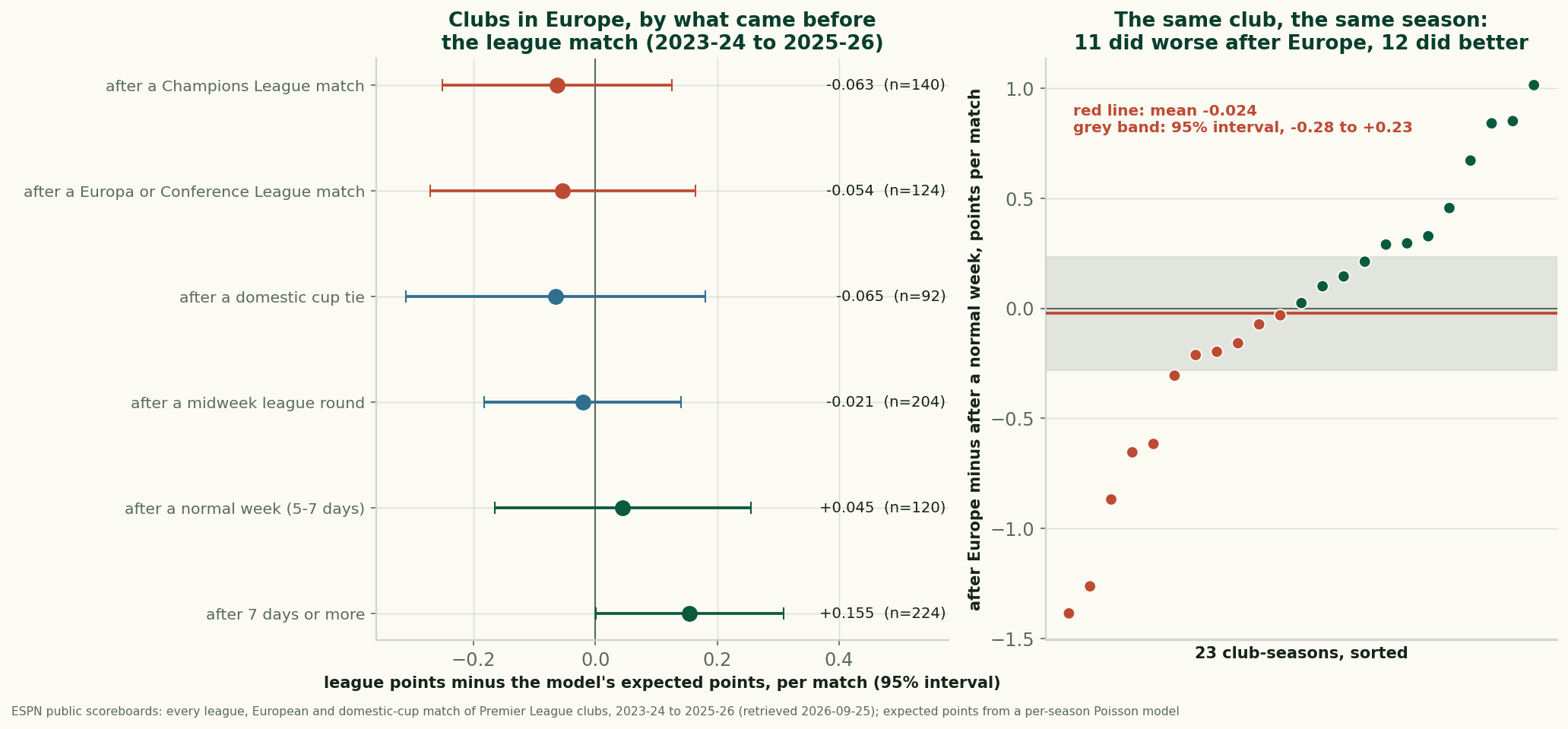
Does Europe Cost English Clubs at the Weekend? Three Seasons Can't Find It
After a European night, English clubs took 1.56 league points a match against 1.62 expected. Within the same club and season the gap is -0.024: not measurable.
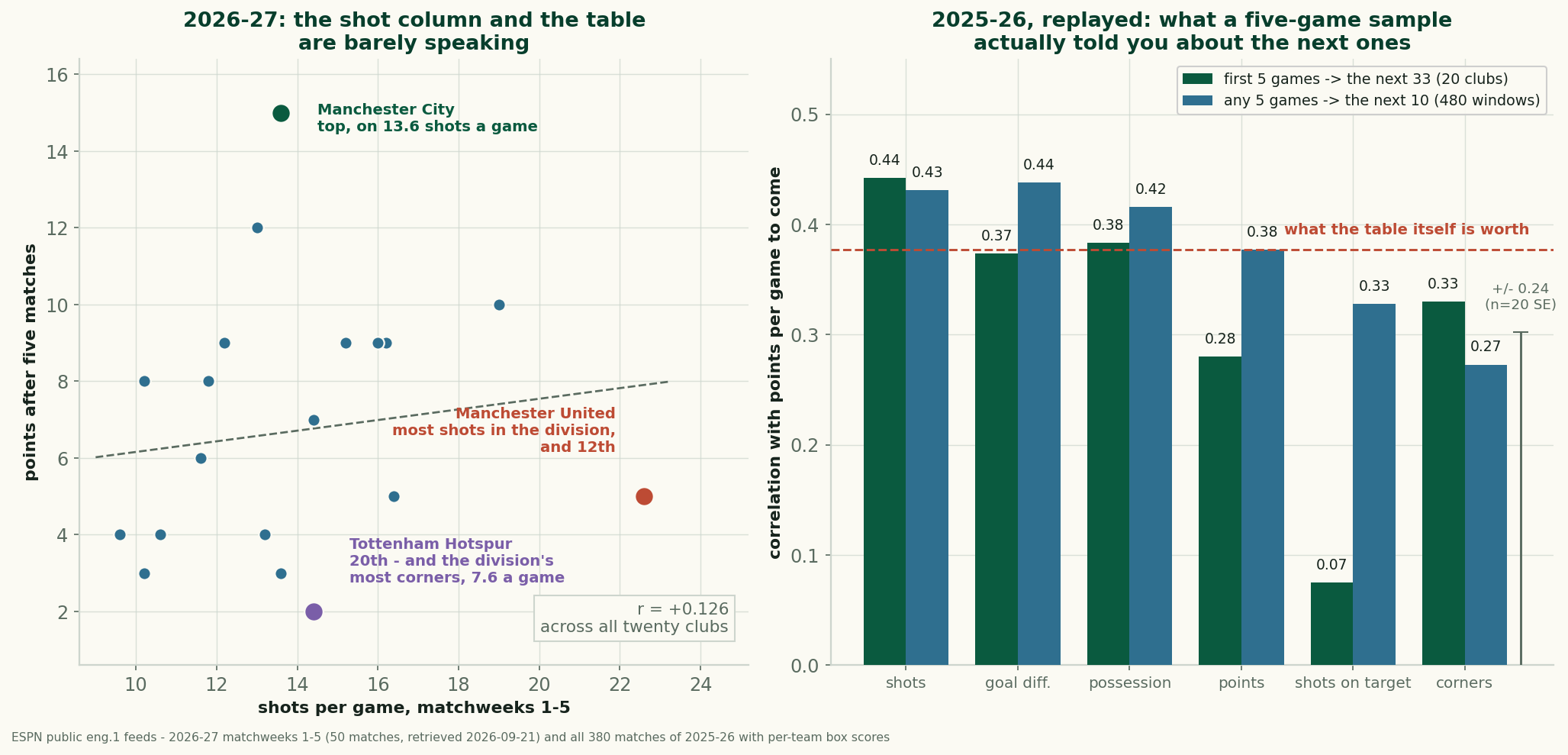
Manchester United Lead the League in Shots and Sit Twelfth
United take 22.6 shots a game and have 5 points. Across 2025-26, a club's five-game shot count predicted its next results better than its points did.
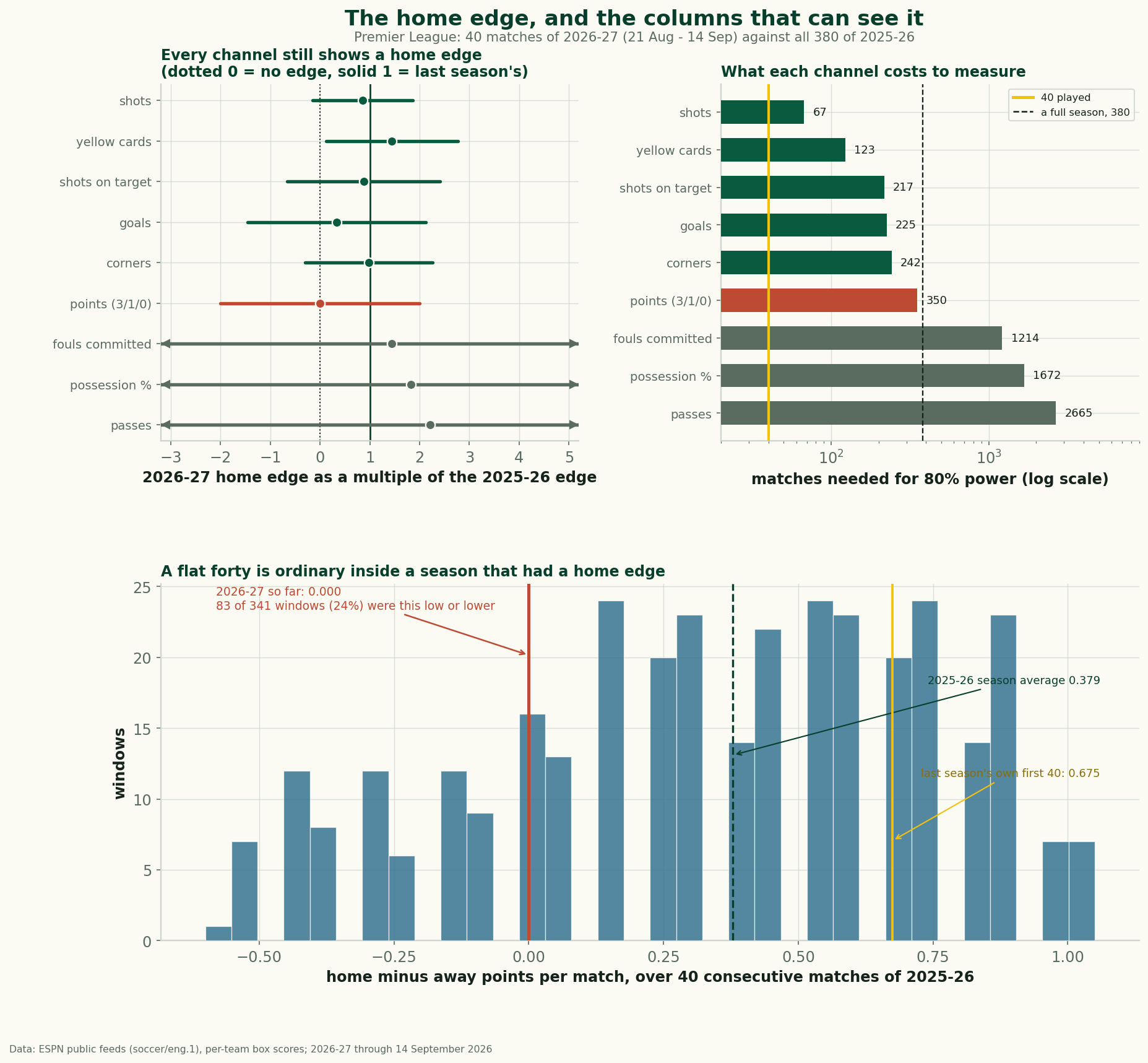
Home Advantage Didn't Die. The Results Column Can't See It
Home and away split the first 40 matches of 2026-27 evenly, yet the shot, corner and card columns keep the home edge. Plus a decade of home-advantage data.