Game State and Score Effects: Why You Can't Read Match Stats Without the Scoreline
A team dominating possession might just be losing.
A team with 65% of the ball, eighteen shots, and the better expected goals was not necessarily the better side. The first question is what the score was. Nine times out of ten the honest answer explains the whole stat line: they were losing. Chasing a deficit is the most reliable way in football to inflate every number a casual viewer treats as proof of control. The scoreline a stat was compiled under is not a detail you check afterwards — it is the first thing you need before the stat means anything at all.
What "game state" means
Game state is the scoreline context in which a statistic was accumulated — whether a team was winning, drawing, or losing at the moment each pass, shot, or tackle happened, and often by how much and with how long left. It sounds like a footnote. It is closer to a hidden variable that shapes almost every number on the match sheet.
The reason is that the scoreline changes how both teams choose to play. A side that goes 1–0 up has its objective flipped: the most valuable thing it can now do is not concede. So it drops deeper, keeps its shape, stops committing bodies forward, and is happy to let the opponent have the ball in front of it. The team that goes 1–0 down has the opposite incentive. It must score, so it pushes players up, takes more risks, presses higher, and shoots from worse positions because a low-percentage shot beats no shot at all. The football you are watching after the first goal is partly a product of the goal, not of the teams' true strengths.
Why it distorts almost everything
Once you see game state, you see its fingerprints on every aggregate stat. The leading team and the trailing team are, in effect, playing two different sports, and the box score blends them into a single misleading average.
- Possession. The clearest victim. A team protecting a lead cedes the ball on purpose; a team chasing the game hoards it because it has to. High possession is therefore as much a symptom of being behind as a sign of control. "Dominating possession" and "losing" are not opposites — they frequently arrive together.
- Shot counts. The trailing team throws bodies and shots forward; the leading team is content to defend and counter. So the team that is behind usually out-shoots the team that is ahead, which inverts the intuition that out-shooting your opponent means you were on top.
- Expected goals. Even xG, the metric built to be more honest than shots, inherits the bias — because xG is summed over shots, and the trailing team takes more of them. A side can lose the match and "win" the xG simply because it spent an hour pouring forward in search of an equaliser. xG totals are more trustworthy than raw shots, but they are not immune to the scoreline. (For what xG does and does not claim, see expected goals explained.)
- Defensive and pressing numbers. Tackles, interceptions, and pressing intensity all swing with game state too — a team defending a lead defends more, presses less, and clears more, none of which means it is a better defensive side.
The slogan that captures the whole phenomenon is simple: losing teams shoot more. It is one of the most robust regularities in football analytics, and it is the reason a raw shot count, or a raw possession figure, can tell you almost the opposite of the truth about who controlled a match.
An illustrative example
Consider two imagined accounts of the same fictional match — the numbers below are made up purely to demonstrate the effect, not drawn from any real game.
| Phase | Team A possession | Team A shots | Team B shots |
|---|---|---|---|
| While level (0–0) | 52% | 4 | 3 |
| After Team A scores (1–0) | 38% | 3 | 11 |
| Full match | 44% | 7 | 14 |
Read only the full-match line and Team B looks dominant: more of the ball late on, fourteen shots to seven. Read the split and the story reverses. While the game was level — the fairest window onto the two teams' true strengths — they were near-even, with Team A marginally on top. Everything that makes Team B's totals look impressive happened after they fell behind and were forced to chase. The single goal did not just change the score; it manufactured the statistics that appear to contradict it.
How analysts adjust
The fix is not to throw the stats away but to condition them on the scoreline. A few standard techniques do most of the work.
Split stats by game state. The simplest and most powerful move: report numbers separately for when a team was winning, level, and losing, instead of mashing them together. The splits often tell three completely different stories, and the contrast between them is itself informative — a team whose performance collapses when ahead has a coaching problem the full-match average would hide.
Lean on the "while level" and early-game numbers. Performance recorded when the score is level is the closest thing to a neutral baseline, because neither team has yet had its incentives distorted. For the same reason, first-half numbers tend to be less score-affected than second-half ones, since more of the first half is typically played at 0–0. Many analysts treat "while level" xG as a cleaner read on which side was actually better than the full-time total.
Use score-state-adjusted models. The most rigorous approach builds the scoreline directly into the model — weighting or correcting each event for the game state it occurred in, so that a shot taken while 2–0 down is not counted the same as one taken at 0–0. This is closely related to possession-adjusting defensive stats so that volume of opportunity does not masquerade as quality; we cover that machinery in possession-adjusted stats.
Why this matters beyond a single match
Game state is not only a single-match trap. It feeds straight into the models that try to project a whole season. If a model ingests raw shot or possession totals without accounting for the scorelines they were built under, it will systematically misjudge teams — over-rating sides that spend a lot of time behind and pile up empty volume, under-rating efficient front-runners who win early and then defend. Differences in exactly how models handle this kind of context are one of the reasons two reputable forecasts of the same league can disagree, as we explore in why league projection models disagree.
The practical takeaway is a habit rather than a formula. Before you let any match statistic settle an argument, ask the first question: what was the score while this number was being made? A possession figure, a shot count, even an xG total means something quite different at 0–0 than it does at 2–0 down with twenty minutes left. The scoreline is not context you can add later. It is the lens the whole box score was shot through.
Sources, notes & further reading
- StatsBomb — analysis and methodology on score effects and game-state splits.
- StatsBomb open data — event data timestamped and scored so events can be bucketed by game state.
- Understat — match and season xG data for the major European leagues.
- FBref — match logs and advanced stats useful for splitting performance by scoreline.
More from Stat Explainers
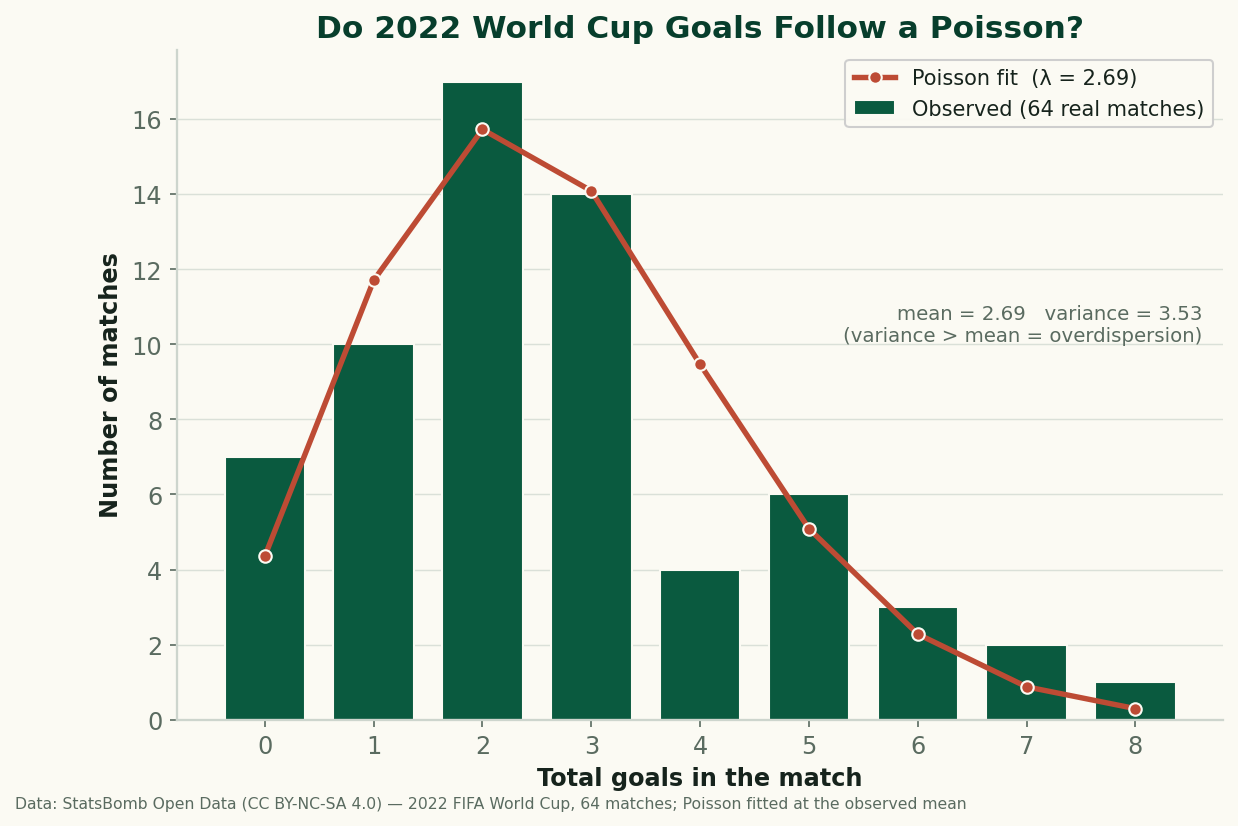
Do Football Goals Follow a Poisson? Testing the Standard Model on All 64 Games of 2022
Every scoreline prediction in football rests on the Poisson. We fit it to all 64 games of 2022 — it gets the shape right, but real goals are overdispersed.
Aerial Duels and Heading Data: Reading Win Rate Without Getting Fooled by Volume
Aerial-duel win percentage, why raw counts mislead, and where aerial dominance actually matters — set pieces, target men, and defending crosses.
Expected Points (xPts): Turning Shot-Level xG Into a Fairer Table
Expected points (xPts) simulates a match from its shot-level xG to get win, draw and loss odds — points that reward chances created, not goals that went in.