Is There Still a Group of Death?
How seeding spreads strength — and whether brutal groups survive it.
There is a particular noise that goes round a room when the draw pairs three serious teams in one four-side group: half the people groaning, the other half delighted it is not their lot. That is the group of death — a cluster with more genuine contenders than qualifying places, guaranteeing somebody good flies home in mid-June. The 48-team format moves the maths around underneath the phrase: more groups, the same seeding logic, a third-placed safety net. Our honest read is that the thing survives, but it is harder to assemble now and a little less lethal when it does. Here is why.
What makes a group deadly
A group of death is not just a group with one strong team; it is a group with too many strong teams for the available qualifying places. In a four-team group where two advance automatically, the danger is a cluster of three or four sides who could all plausibly finish in the top two, which mathematically guarantees at least one good team finishes third or fourth. The “death” is the surplus of quality relative to the two qualifying slots.
So the question of whether deadly groups exist is really a question about how strength is distributed across the groups. If the draw scattered teams at random, you would occasionally get a brutal cluster and occasionally get a soft one. Tournaments do not draw at random, though — they seed, precisely to stop the worst clusters from forming. The whole design tension is between the seeding that spreads strength out and the residual randomness that can still pile it up.
How seeding spreads the strength
Seeding works by sorting teams into pots by strength — typically a top pot of the highest-ranked sides, then descending pots — and drawing one team from each pot into every group, so no group can contain two top-pot teams. Applied across the 2026 field, the logic places one of the strongest teams in each of the twelve groups, then one from the next tier, and so on, deliberately preventing the heavyweights from colliding in the group stage.
This is exactly the mechanism that limits groups of death. If every group is guaranteed precisely one top-pot side, the only way to assemble a deadly group is for the lower pots to deliver unusually strong teams into the same group as that top seed — a second-pot side that is really of first-pot quality, plus a dangerous third-pot side. That happens, because pot boundaries are imperfect and rankings do not capture form, but it is constrained. Seeding cannot stop a group of death entirely; it can only require bad luck to lower more than one heavyweight into the same place.
| Pot | Typical strength | Group-of-death risk it adds |
|---|---|---|
| Pot 1 | Strongest seeds | One per group by design — baseline |
| Pot 2 | Strong, uneven | High if an elite side sits here |
| Pot 3 | Mid-tier, some dangerous | Moderate — the tipping factor |
| Pot 4 | Lowest-ranked | Low — rarely the difference |
What the 48-team format changes
Expansion pulls in two directions at once, and they partly cancel. On one hand, twelve groups instead of eight means more groups in which a tough cluster could form — more draws, more chances for the pots to misbehave. On the other, the wider field is filled out at the bottom by the sixteen newest, generally lowest-ranked qualifiers, which means each group is now likelier to contain at least one clearly weaker side. A four-team group with one minnow in it has, in effect, three teams fighting for two places rather than four — which dilutes the very surplus of strength that defines a group of death.
The seeding also still does its core job: one top seed per group, heavyweights kept apart. So the typical 2026 group is, if anything, slightly less likely to be a true group of death than a typical group in a smaller, more uniformly strong field, because the strength is spread across more groups and each group tends to carry a weaker fourth team. The deadliest groups require the same accident as ever — a top-heavy pot draw — just against a backdrop where the average group is more lopsided.
The third-placed safety net
There is one more factor that genuinely defangs the concept, and it is specific to this format: the eight best third-placed teams advance. In the old format, finishing third meant elimination, full stop — so a group of death really did kill, sending a strong third-placed side straight home. In 2026, a strong team that finishes third in a brutal group can still qualify as one of the best thirds, the cross-group ranking explained in the best third-place math.
That changes the stakes. A genuine group of death might now “only” push a good team down to third, from where it can still scrape into the round of 32. The group is still hard — finishing third is worse than first, and a best-third finisher likely faces a tougher knockout draw — but it is no longer automatically fatal. The safety net converts some would-be deaths into mere serious inconveniences. The phrase survives; its literal lethality is reduced.
Quantifying it, carefully
You can put rough numbers on group difficulty using power ratings — sum or average the ratings of a group’s four teams, and a group whose total sits far above the field average is your candidate group of death. The systems that produce those ratings, and why they disagree, are covered in soccer power ratings; the same machinery feeds the projection models discussed in why projection models disagree, which can simulate a group thousands of times and report each team’s qualification probability. When a four-team group shows three sides with meaningful but middling advance probabilities — nobody safe, nobody doomed — that is a group of death in the language of models.
The necessary caveat: none of this can be applied to the actual 2026 draw here, because the specific groups are not something to assume. The framework is general. Once the real draw exists, the method is simple — rate the teams, total each group, simulate, and look for the groups where too much quality is chasing too few places. The group of death is not dead. It is rarer, better cushioned, and now best identified with a simulator rather than a gasp at the draw. For the wider numbers behind the tournament, see World Cup 2026 by the numbers.
Where these numbers come from
- FIFA — the official draw procedure and seeding pots, which govern how strength is distributed across groups.
- FBref — team and competition data useful for building the strength estimates behind any group-difficulty assessment.
- RSSSF — historical group draws, useful for studying which past groups truly merited the label.
More from World Cup 2026
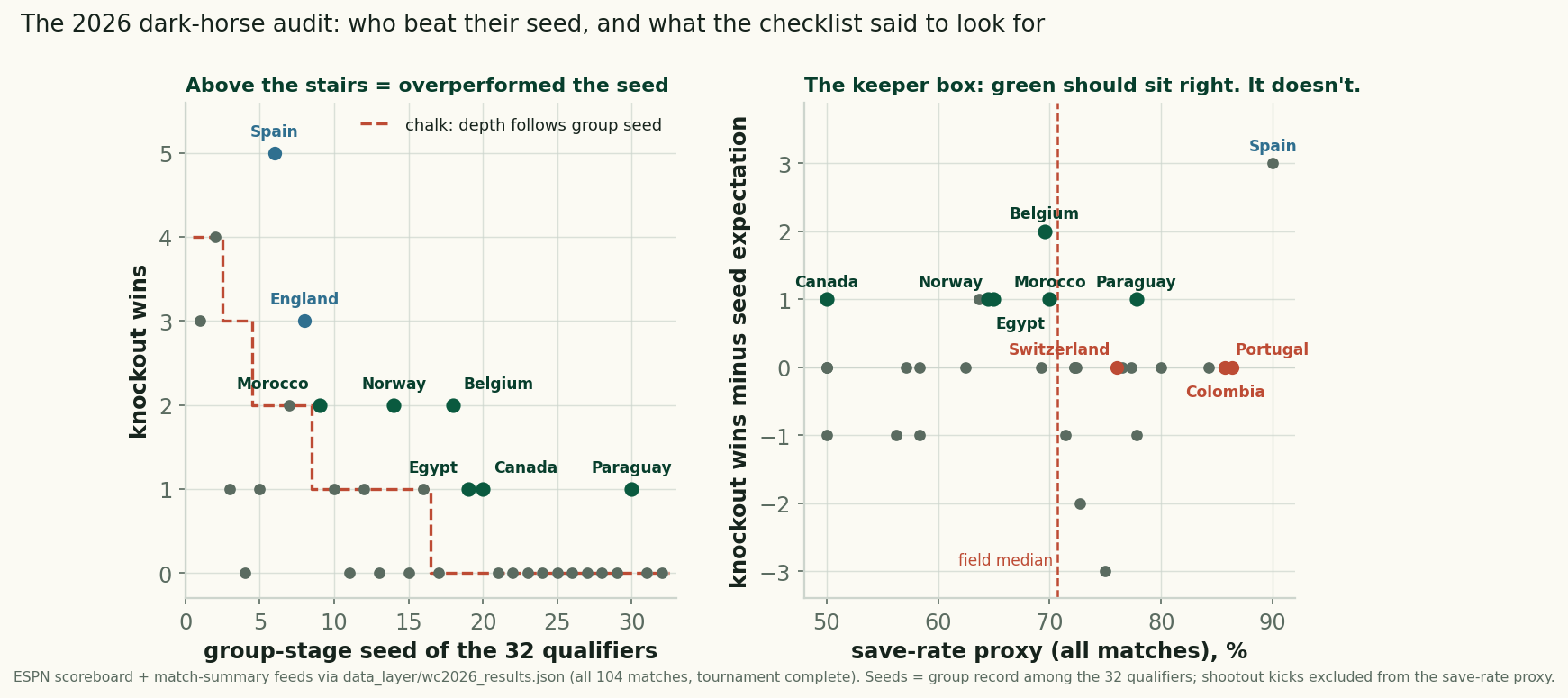
The 2026 Dark-Horse Audit: Grading Our June Checklist
Six teams beat their group seed at the 2026 World Cup, scored against our pre-tournament checklist: the keeper box failed, the kind draw barely helped.
The Shootouts: Rarer, Earlier, and a Reprieve That Never Lasted
Retro #4 closes the series: the shootout rate fell to 12.5% of knockout games from 2022's 31%, all four came early, and survivors went 1-3 next time out.
The Groups Told the Truth: How June Predicted July at the 2026 World Cup
Group-stage points strongly predicted knockout survival: 9-point teams went 3-for-3, 4-point teams 2-for-11, and the last four all ranked top-8.