The Longest Knockout Bracket: 32 Teams to One
An extra round, an eighth match, and a longer road to the trophy.
For decades, the road to a World Cup final had a fixed length. Sixteen teams entered the knockout stage, and the champion played a round of 16, a quarter-final, a semi-final and a final — four single matches with no second leg, no aggregate, no safety net. The 2026 format keeps that structure intact and adds a new round in front of it. Thirty-two teams now enter the knockouts, the bracket gains a full extra tier, and the team that lifts the trophy will have survived one more do-or-die match than any previous winner. That extra round changes more than the length of the path.
The shape of the new bracket
The 2026 knockout stage runs round of 32, round of 16, quarter-finals, semi-finals, final. Thirty-two teams qualify — the top two of each of the twelve groups plus the eight best third-placed teams, the arithmetic of which is in the best third-place math — and from there it is straight single-elimination. Win and advance; lose and fly home. There is no group-stage cushion left and no two-legged tie to recover in; every round is one match.
The new tier is the round of 32, sixteen matches that did not exist in the old format. It sits at the front of the bracket, so the highest-seeded teams that win their groups enter there facing, in principle, lower-ranked opposition — runners-up and third-placed qualifiers. Everything from the round of 16 onward looks structurally like the tournament always did; what changed is that an entire round was added before it.
Eight matches to lift the trophy
Here is the number that captures the change. Under the old 32-team format, the champion played three group matches and then four knockout rounds — round of 16, quarter-final, semi-final, final — for a total of seven matches across the tournament. In 2026, the champion still plays three group matches, but now five knockout rounds: round of 32, round of 16, quarter-final, semi-final, final. Three plus five is eight.
So the 2026 winner will play eight matches, one more than the seven that won every World Cup from 1998 through the last edition. It is a single extra game, but it is an extra knockout game — the most demanding kind, played at maximum intensity with elimination on the line — and it is added at the start of the most congested phase of the tournament.
| Stage | Old (32 teams) | 2026 (48 teams) |
|---|---|---|
| Group stage | 3 | 3 |
| Round of 32 | — | 1 |
| Round of 16 | 1 | 1 |
| Quarter-final | 1 | 1 |
| Semi-final | 1 | 1 |
| Final | 1 | 1 |
| Total | 7 | 8 |
What an extra knockout round does
Adding a round is not just adding a fixture; it changes the character of the tournament in three measurable ways.
Fatigue and load. An eighth match, and specifically a fifth knockout match, means more minutes in the legs of the deepest-running teams during the back half of the event. The squads that reach the final will have played more high-intensity football than any finalists before them, compressed into the same broad summer window. Deeper benches help — the move to five substitutes, explored in the five-substitutions era, gives managers more ways to manage that load — but the underlying demand is higher than it has ever been, and the travel involved in a continent-sized host map compounds it.
Variance. Every single-elimination match is, to some degree, a coin flip that quality only weights rather than decides. A better team wins a given knockout tie more often than not, but not always — a deflection, a red card, a shoot-out, and the favourite is out. Stringing five such matches together instead of four means the eventual winner has to survive one more of these high-variance events. Probabilistically, that makes the bracket slightly less likely to be won by the single strongest team and slightly more open to a hot run. It is one more place for the upset that defines World Cups to happen.
More single-game knockouts overall. Beyond the champion’s own path, the tournament now stages sixteen extra elimination matches across the field — the entire round of 32. That is sixteen more occasions for a giant to wobble, for a lower-ranked side to produce the performance of its life, for a penalty shoot-out to send someone home who created more and conceded less. The volume of jeopardy goes up, not just its length.
The seeding cushion — and its limits
The format does try to protect the strongest teams from the new round’s danger, at least at first. Because group winners are likely to enter the round of 32 against runners-up or third-placed qualifiers, the early knockout matchups are, on paper, the most lopsided. A dominant group winner facing a struggling third-placed side is the kind of tie the seeding is designed to produce, and it gives the favourites a softer first knockout step than a straight open draw would.
But the cushion is thin, for two reasons. First, the eight best third-placed teams that fill out the bracket are, by definition, decent — they finished third in a competitive group and beat out other thirds to get in, so they are not pushovers. Second, single-elimination football does not respect seeding for long; one upset and the bracket reshuffles. The cushion softens the first step, not the whole staircase. How hard those groups can be in the first place — and whether the “group of death” still exists to send a strong team down to third — is taken up in is there still a group of death.
The net effect is a tournament that is longer at the top, wider at the base, and slightly more open to chaos throughout. The trophy now sits at the end of an eight-match road instead of a seven-match one, and the extra match is the hardest kind there is. For how this longer bracket fits the broader 104-match arithmetic, see why 104 matches.
Sources & further reading
More from World Cup 2026
The 2026 Dark-Horse Audit: Grading Our June Checklist
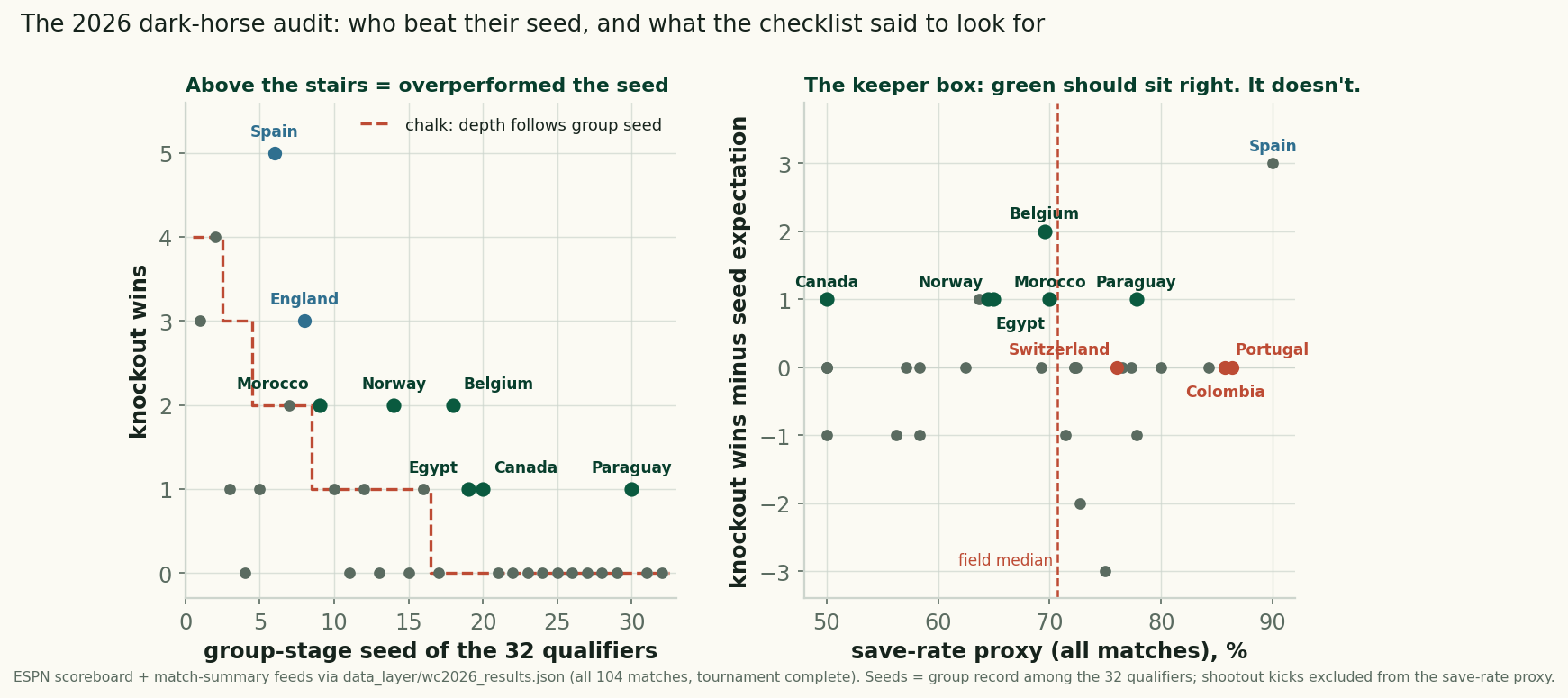
Six teams beat their group seed at the 2026 World Cup, scored against our pre-tournament checklist: the keeper box failed, the kind draw barely helped.
The Shootouts: Rarer, Earlier, and a Reprieve That Never Lasted
Retro #4 closes the series: the shootout rate fell to 12.5% of knockout games from 2022's 31%, all four came early, and survivors went 1-3 next time out.
The Groups Told the Truth: How June Predicted July at the 2026 World Cup
Group-stage points strongly predicted knockout survival: 9-point teams went 3-for-3, 4-point teams 2-for-11, and the last four all ranked top-8.