Why the World Cup Expanded to 48 Teams
The case for a bigger World Cup, and what it costs.
The World Cup has always grown. It is easy to treat the jump to forty-eight teams as a radical break, but the tournament has been getting bigger for most of its history, in deliberate steps, each justified by the same handful of arguments and resisted with the same handful of objections. Understanding why 2026 expanded means understanding both the recurring case for growth — access, revenue, more places for more confederations — and the recurring cost: a more diluted field, more mismatches, more matches that are decided before kick-off. The 48-team edition is the latest move in a very old pattern.
A short history of getting bigger
The expansion of 2026 is not unprecedented; it is the third major enlargement of the modern era. The World Cup finals ran with sixteen teams for decades, then expanded to twenty-four teams for the 1982 tournament, then to thirty-two teams for the 1998 tournament, the format that held for seven editions. The move to forty-eight teams for 2026 is the next step in that sequence. Each expansion was roughly a generation apart, and each was larger in absolute terms than the last.
Seen against that history, forty-eight is less a revolution than a continuation. The tournament has spent its whole life trending upward in size, driven by a steadily growing global game in which far more national associations field competitive teams than the finals could ever accommodate. The pressure to let more of them in has been constant; 2026 is simply the latest release of it.
| From | Teams | Matches |
|---|---|---|
| Long-running format | 16 | 32 |
| 1982 | 24 | 52 |
| 1998 | 32 | 64 |
| 2026 | 48 | 104 |
The case for expansion
Three arguments do most of the work in favour of a bigger tournament, and they are not frivolous.
Global access. A 32-team field left whole regions with only a handful of places, and qualification could exclude nations with real footballing cultures and large, passionate followings on the thinnest of margins. Expanding to forty-eight widens the door, giving more confederations more slots and more countries a realistic path to the finals. For a sport that calls itself the world’s game, broadening who actually gets to play in its showcase has a genuine logic; the distribution of those slots across confederations, and how it has shifted, is the subject of confederations at the World Cup.
Revenue. More teams means more matches — 104 rather than 64 — and more matches means more broadcast inventory, more ticketed games, more sponsorship surface and more host-city activity. The financial case is straightforward and large, and it funds, in principle, investment back into the global game. It would be naive to pretend revenue is not a primary driver; it plainly is, and the arithmetic of the extra matches is laid out in why 104 matches.
More confederation places. Beyond raw access, expansion lets the global federation rebalance how many places each confederation receives, easing long-standing complaints that some regions were under-represented relative to their number of associations. More slots to distribute makes that politics easier to manage, which is itself part of why expansion is attractive to the organisation that runs it.
The trade-offs
None of that is free, and the objections are as durable as the arguments.
Dilution. The sixteen additional teams are, broadly, the lowest-ranked sides ever to reach the finals. A wider field means a longer tail of weaker teams, and the average quality of a randomly chosen match falls. Purists argue the World Cup should be the best of the best, and that admitting more teams trades exclusivity — part of what made qualification meaningful — for inclusivity.
Mismatches and dead rubbers. More weak teams means more lopsided games, particularly in the group stage, where a clearly stronger side can overwhelm a debutant. It also raises the spectre of dead rubbers — final-round group games with nothing at stake — though the format fights this specific problem deliberately, as discussed below. The risk of blowouts that tell you little is real, and it shows up in the wider scoring numbers explored in World Cup 2026 by the numbers.
How the format hedges its own bet
The most interesting feature of the 48-team design is that it tries to mitigate its own biggest risk. An obvious worry with four-team groups where two advance is the dead rubber: a team that wins its first two games has nothing to play for in the third, and a team that loses its first two is already out, so the final round risks meaningless matches. The format’s answer is the third-placed safety net — the eight best third-placed teams qualify, the mechanism detailed in the best third-place math.
Because third place can still mean qualification, far fewer teams are truly dead before the final round, and the margin of results — goal difference, goals scored — keeps mattering even in games that look settled, since the standard group tiebreaker ladder rewards how much a team wins by, not just whether it wins. It is an elegant patch: the same expansion that creates the dilution risk also installs a mechanism that keeps more teams playing for something for longer. Whether it fully compensates is a fair debate, but the design clearly anticipated the objection.
The honest verdict
The expansion to forty-eight is best understood as a values choice dressed in arithmetic. If you weight access, growth and global representation heavily, it is a defensible — even overdue — continuation of a century-long trend toward a more inclusive tournament. If you weight competitive purity and the meaning of scarce qualification, it is a dilution that buys breadth at the cost of edge. Both readings are coherent; they disagree about what the World Cup is for, not about the facts.
What is not in dispute is the historical pattern. Sixteen became twenty-four, twenty-four became thirty-two, and thirty-two has become forty-eight, each step contested and each step taken anyway. The tournament that kicks off in 2026 is the largest in its history, and on the evidence of that history, it is unlikely to be the last enlargement. The structural consequences of this particular expansion — the longer knockout bracket, the rest and travel a continental host map imposes, the diminished but surviving group of death — are where the real arguments now move, from whether to expand to how to absorb the result.
The data behind this piece
More from World Cup 2026
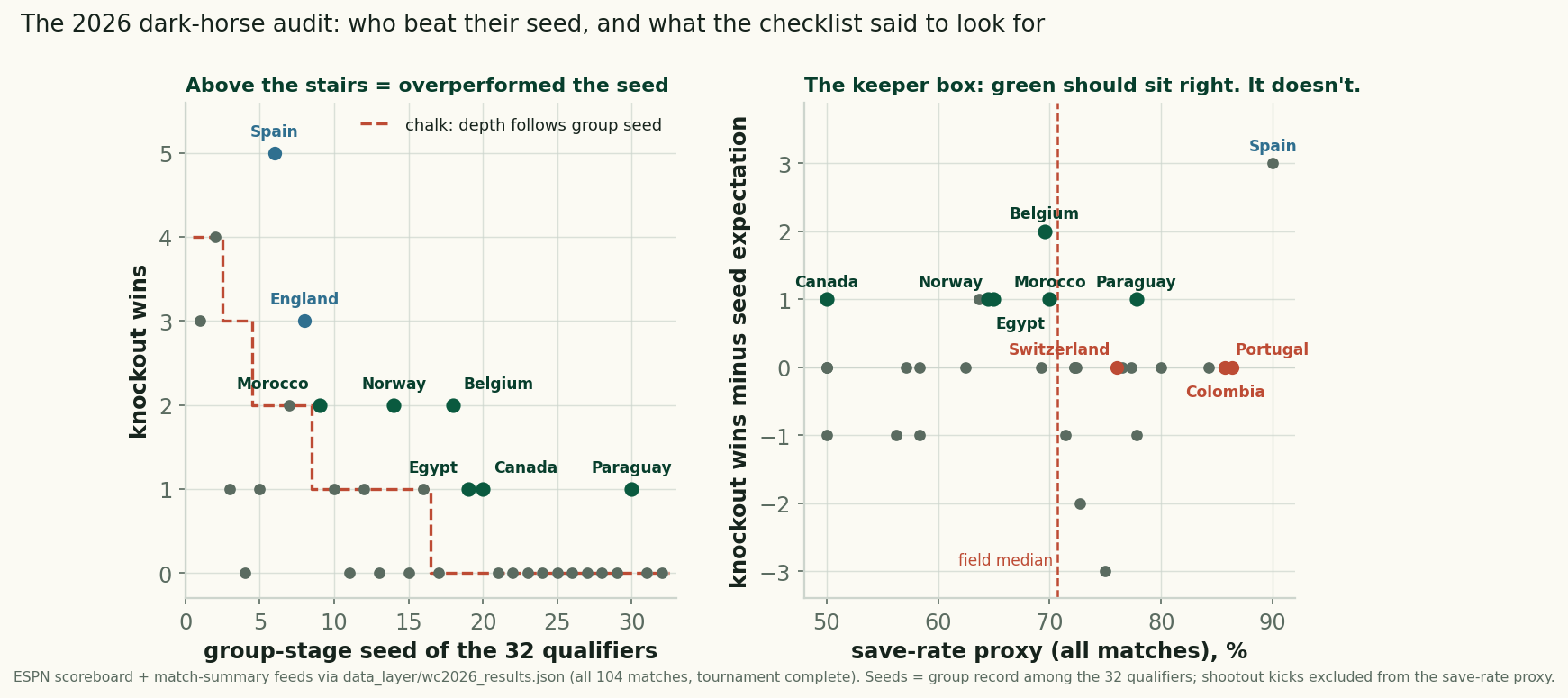
The 2026 Dark-Horse Audit: Grading Our June Checklist
Six teams beat their group seed at the 2026 World Cup, scored against our pre-tournament checklist: the keeper box failed, the kind draw barely helped.
The Shootouts: Rarer, Earlier, and a Reprieve That Never Lasted
Retro #4 closes the series: the shootout rate fell to 12.5% of knockout games from 2022's 31%, all four came early, and survivors went 1-3 next time out.
The Groups Told the Truth: How June Predicted July at the 2026 World Cup
Group-stage points strongly predicted knockout survival: 9-point teams went 3-for-3, 4-point teams 2-for-11, and the last four all ranked top-8.