Squad Depth and the Five-Sub Era at World Cup 2026
Why the bench has never mattered more at a World Cup.
For most of World Cup history the starting eleven was the team, and the bench was an emergency fund — three changes held in reserve for injuries and the closing scramble. Three forces have now converged to change that calculus, and they all point the same way: at the 2026 World Cup, squad depth matters more than at any tournament before it. The case is not that benches were ever irrelevant; it is that a specific combination of rule, structure and conditions has raised the price of being top-heavy and the reward for being deep.
Force one: five substitutes, permanently
The first change is the most concrete. Football moved from three substitutes to five, a shift that began as a pandemic-era measure and was subsequently written permanently into the Laws of the Game. Five changes — typically across three stoppage windows — mean a manager can replace nearly half the outfield over ninety minutes. The full story of how that reshaped the closing stages is in the five-substitutions era; the consequence for tournament squads is that the eleventh through fourteenth players on a roster are no longer ornamental. They will play meaningful minutes, often at decisive moments, and the gap between a side's first choice and its replacements becomes a live competitive variable rather than a footnote.
Two extra changes per match does not sound dramatic. Compounded across a tournament run, it is. A side that can bring on genuine quality to hold a lead, refresh a midfield, or change a game chasing one, match after match, is exploiting a resource that the three-sub era simply did not offer — and a side whose bench drops off a cliff cannot.
Force two: a longer road to the trophy
The expanded format lengthens the bracket. With 48 teams and a knockout stage that begins at 32, the path to the final runs through more matches than past editions, and the eventual champion plays more games than a winner used to — the structural arithmetic is laid out in World Cup 2026 by the numbers and the format rationale in why 104 matches for a 48-team format. More matches, often on short rest, is more accumulated fatigue and more exposure to suspensions and knocks. A war of attrition rewards the side with reserves, and an expanded tournament is a longer war.
Force three: heat and altitude
The third force is the playing environment. A summer tournament across this region raises the prospect of serious heat for some fixtures, and one host city sits at major altitude — both conditions that raise the physiological cost of the same running and accelerate fatigue, as documented in altitude and heat at the 2026 venues. When every player on the pitch is tiring faster, the ability to introduce fresh legs is worth more than in mild conditions, and rotation between matches becomes a necessity rather than a luxury. Heat and a five-sub allowance interact multiplicatively: the rule gives you the tool, the conditions create the need.
What "depth" actually means here
It is worth being precise, because depth is often used loosely. For a 2026 tournament squad it has three components. The first is drop-off: how far a team's quality falls from its first eleven to its replacements. A gentle drop-off means substitutions maintain the level; a steep one means every change weakens the side. The second is positional cover: a deep squad has real options in every line, so a suspension at centre-back or a hamstring in midfield does not force a square peg into a round hole. A squad can look deep on paper and still be thin in the one position that gets injured. The third is rotation viability: enough quality to rest starters between matches without conceding the game, which over a long bracket keeps the best players fresher for the rounds that matter.
These map directly onto why depth is a genuine predictor of deep runs rather than a cliché — the argument in what predicts a deep World Cup run. A team that survives the attritional middle of a tournament with its best players still standing is often a team that could afford to rotate and to absorb losses, and that affordance is depth.
Who the change favours
The honest generalisation is that these forces tilt the field toward nations with broad, elite player pools — the same set that has historically supplied the favourites, for the same underlying reason: depth of talent. A country that can field a credible second-choice player in most positions banks an advantage that compounds across a long, hot tournament, while a side carried by a brilliant first eleven and little behind it is more exposed than ever to a single injury or a fixture too many. This is a tendency, not a verdict on any specific squad — final rosters and who is fit on the day are not knowable in advance — but it is a defensible lens for reading the tournament. It also feeds the dark-horse calculus: a mid-tier side with surprising depth is better placed to overperform than its rating alone implies, one ingredient of the profile in how to spot a dark horse.
How forecasts handle it
Most power ratings capture squad strength only indirectly, through results and chance quality, and they do not natively know how a team's twelfth player compares to its first. That is part of why depth is one of the adjustments a careful analyst makes on top of a rating, and why models can disagree about teams whose bench quality diverges from their headline strength — the same kind of input choice that drives the disagreements in why league projection models disagree. The takeaway for 2026 is straightforward and unusually robust: in a longer, hotter tournament with five substitutes, the teams that can change the game without weakening it hold an edge that did not exist a few years ago — and it is one of the more reliable things you can say before a ball is kicked.
Sources, notes & further reading
- FIFA — the Laws of the Game (via IFAB) on substitutions, plus tournament format and squad-size rules.
- FBref — minutes, squad usage and rotation data useful for measuring drop-off and positional cover.
- StatsBomb — event data and research on substitute impact and late-game performance.
- ClubElo — a rating baseline against which depth-driven over- or under-performance can be assessed.
More from World Cup 2026
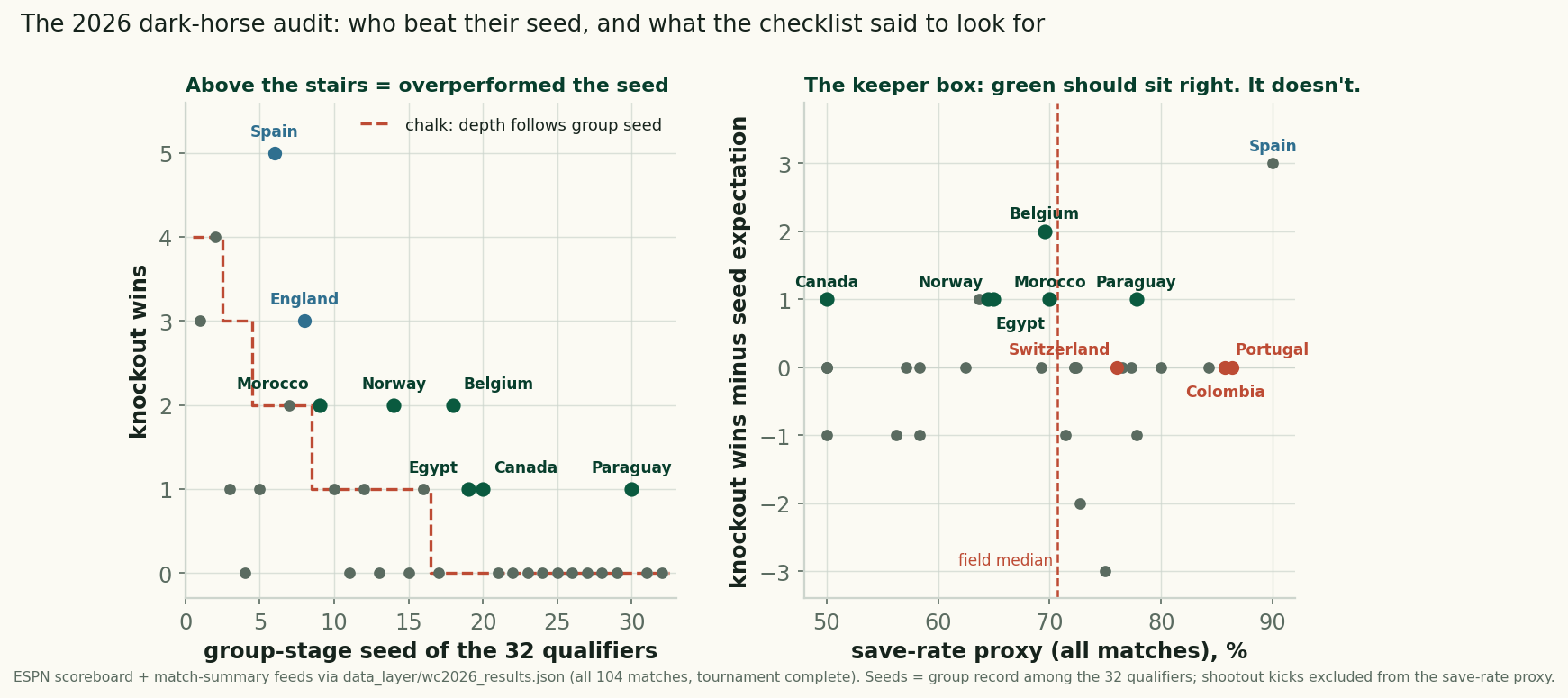
The 2026 Dark-Horse Audit: Grading Our June Checklist
Six teams beat their group seed at the 2026 World Cup, scored against our pre-tournament checklist: the keeper box failed, the kind draw barely helped.
The Shootouts: Rarer, Earlier, and a Reprieve That Never Lasted
Retro #4 closes the series: the shootout rate fell to 12.5% of knockout games from 2022's 31%, all four came early, and survivors went 1-3 next time out.
The Groups Told the Truth: How June Predicted July at the 2026 World Cup
Group-stage points strongly predicted knockout survival: 9-point teams went 3-for-3, 4-point teams 2-for-11, and the last four all ranked top-8.