The Clean Sheet Is the Most Valuable Thing at the 2026 World Cup
Keep them out and you average 2.45 points a game. Let one in and it's under one. The clearest edge in the tournament.
There's an old defensive cliché — “keep a clean sheet and you can't lose” — and at the 2026 World Cup it's almost literally true. Through 44 completed matches, a team that kept the opposition off the scoreboard averaged 2.45 points per game and won 73% of the time. A team that conceded even one goal averaged under a point. The clean sheet is the single most valuable outcome a team can engineer in this tournament, and the gap between shutting the door and leaving it ajar is enormous.
Sourcing. Every figure is from the 44 completed matches only (88 team-games), from ESPN's public match feed, retrieved June 23, 2026. A dated snapshot, taken while the tournament was still being played; completed games only, nothing invented. The closing update above carries the final figures.
The exhibit: points by clean sheet
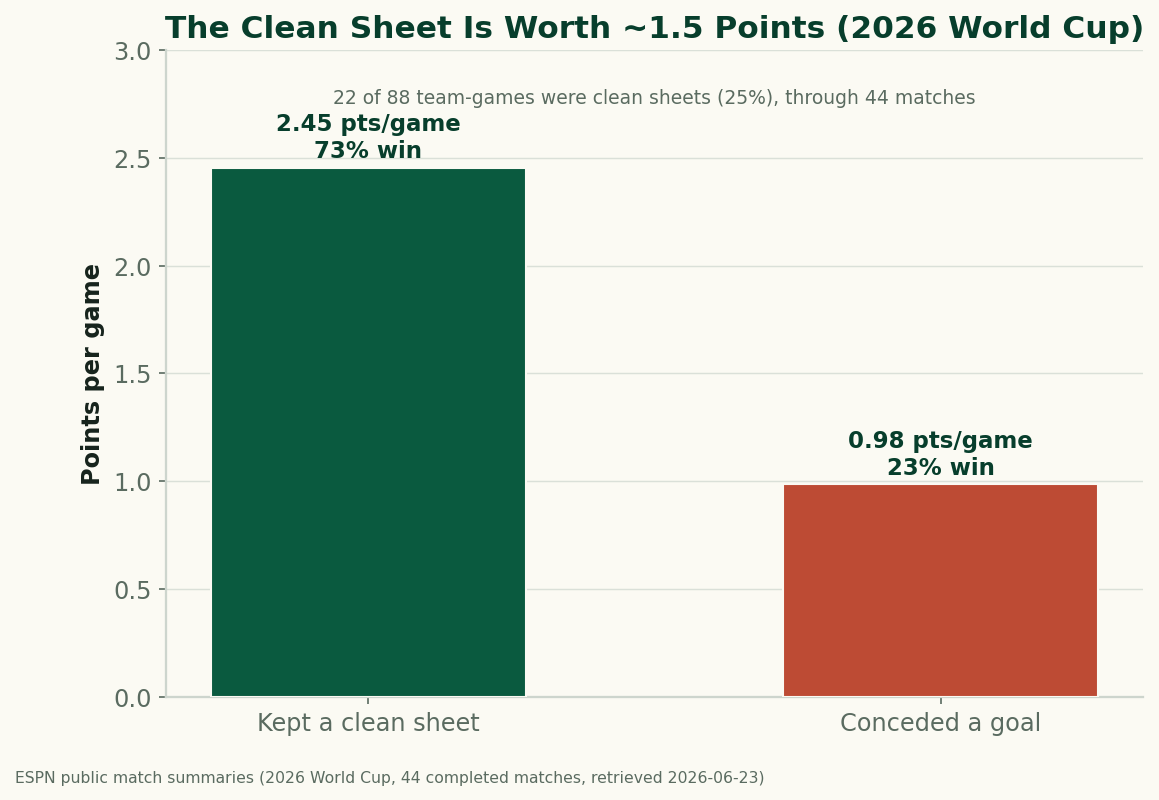
The mechanism is half-arithmetic, half-skill. A clean sheet guarantees at least a draw — you cannot lose 0-0 — so the floor is one point before you've scored a single goal. Add even one goal of your own and the clean sheet becomes three points. That's why shutting out the opponent is worth nearly two and a half points on average: it eliminates the loss column entirely and converts most of those games into wins. Conceding, by contrast, opens up all three results, and the average collapses to under a point.
How common is a shutout here?
25% of team-games have ended in a clean sheet so far — one in four. That's a meaningful share, and it tells you the 2026 World Cup, for all its blowouts and high-scoring openers, still produces plenty of locked-down defensive performances. And those performances are disproportionately rewarded: a quarter of team-games are clean sheets, but they account for a hugely outsized share of the points won. Defense doesn't just prevent losses here — it manufactures wins.
Why this is the cleanest edge in the tournament
Compare it to the other levers we've measured. Possession barely moves the win rate; out-shooting your opponent helps but scatters; finishing is mostly small-sample luck. The clean sheet is different because it's not a noisy proxy for winning — it's nearly equivalent to not losing. The 2.45-points-per-game figure isn't a subtle correlation you have to squint at; it's the direct consequence of removing the worst outcome from the table. If a coach could guarantee one thing before kickoff, “don't concede” would be worth more than any amount of possession or territory.
A worked example: the floor and the ceiling
Think of a clean sheet as resetting the possible outcomes of a match. A team that has conceded can still win, draw, or lose — all three are live, and across the conceding team-games here that averaged out to 0.98 points, almost exactly the value of a single draw spread across wins and losses. A team that has not conceded has deleted the loss: its worst case is a goalless draw (one point), and its best case — the moment it scores once — is the full three. So the clean sheet doesn't just nudge the odds, it removes the bottom of the distribution. That's why the average leaps from under one point to nearly two and a half: you're not making wins more likely so much as making losses impossible. With only 3 of the 44 matches finishing 0-0, the “worst case” of a clean sheet has rarely even happened — teams that keep the back door shut have almost always found a goal at the other end.
The honest caveats
- Causation runs both ways. Keeping a clean sheet helps you win, but being the better team also makes both a clean sheet and a win more likely. Some of the 2.45 is “good teams shut out weaker ones and win,” not “the shutout itself caused the win.” The clean sheet is partly a marker of dominance, not only a driver of results.
- It's nearly tautological at the edges. A clean sheet guarantees at least a point, so part of the gap is definitional rather than a discovered effect. The interesting, non-tautological part is the 73% win rate — clean sheets aren't just 0-0 bores (only 3 of 44 matches were goalless); teams keeping shutouts are usually also scoring.
- Small, early sample. Eighty-eight team-games is enough for a tournament-wide rate but not for fine splits, and knockout caution was still to come when this was written. The closing update at the top of this page records where the 2.45 and the 73% finished.
- One source, and a snapshot. Counts come from a single public feed, and this was a moving snapshot when it was published; it is closed out above.
The takeaway
At the 2026 World Cup so far, the surest path to points isn't dominating the ball or peppering the goal — it's keeping the other team off the board. A clean sheet has been worth about two and a half points a game and a 73% win rate, against under a point when you concede. Some of that is good teams being good, but the lesson the cliché was always pointing at holds up in the data: in a tournament, the cheapest way to win is to make sure you don't lose — and you don't lose if they don't score.
Reproduce it
For each team-game in data_layer/wc2026_results.json, flag a clean sheet (opponent scored 0), assign points (3/1/0), and average points and win rate within the clean-sheet and conceded buckets. The chart is drawn by charts/chart_wc2026_clean_sheets.py. No network at build time, nothing hand-entered.
Sources & further reading
- 2026 results: bundled
data_layer/wc2026_results.json— ESPN public match feed, 44 completed matches, retrieved 2026-06-23. Charted bycharts/chart_wc2026_clean_sheets.py. - Companion: What actually wins games and clinical or wasteful finishing at the 2026 World Cup.
- Background: Expected goals and goalkeeper metrics — the chance-prevention side of a clean sheet.
More from World Cup 2026
The 2026 Dark-Horse Audit: Grading Our June Checklist
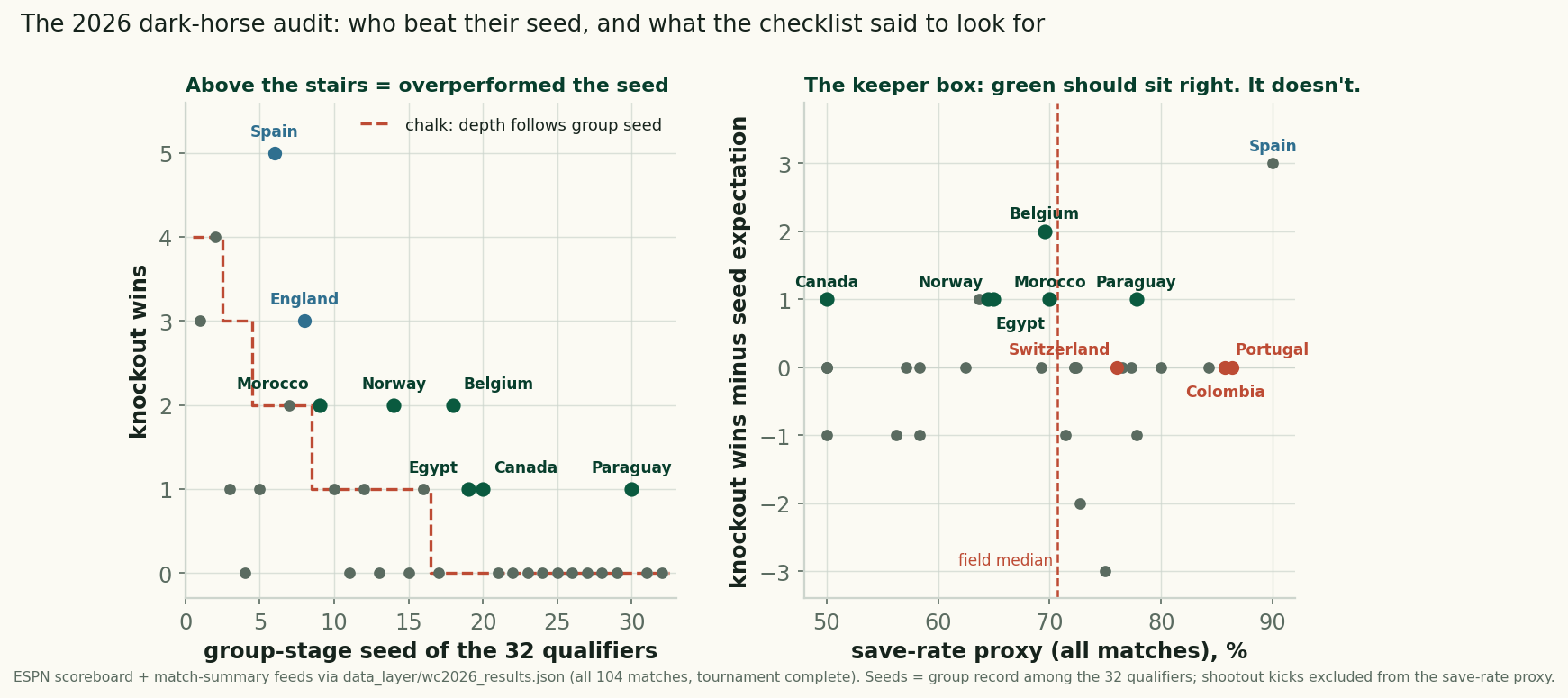
Six teams beat their group seed at the 2026 World Cup, scored against our pre-tournament checklist: the keeper box failed, the kind draw barely helped.
The Shootouts: Rarer, Earlier, and a Reprieve That Never Lasted
Retro #4 closes the series: the shootout rate fell to 12.5% of knockout games from 2022's 31%, all four came early, and survivors went 1-3 next time out.
The Groups Told the Truth: How June Predicted July at the 2026 World Cup
Group-stage points strongly predicted knockout survival: 9-point teams went 3-for-3, 4-point teams 2-for-11, and the last four all ranked top-8.