Headers vs. Feet: Which World Cup Shots Actually Go In?
Headers aren't the wasteful shot you think — they convert as well as feet, because they come from closer. The real outlier: the left foot beat its expected goals by a mile.
Ask almost anyone who has watched enough football and they will tell you the same thing: heading is a bad way to try to score. You see a striker rise to meet a cross, glance it wide, and the folk wisdom hardens — headers are wasteful, low-percentage, a shot you take because nothing better is on. It is a widely held view. Counting the 2022 World Cup's shots says something more interesting than the cliché.
Here is the headline before anything else: at Qatar 2022, headers converted at essentially the “same” rate as shots with the feet. Not worse. The genuine outlier in the data isn’t the head at all — it’s the left foot, which beat its expected goals by the widest margin of any body part on the pitch.
Every number in this piece is computed from StatsBomb’s free, public event data for all 64 matches of the 2022 World Cup. Penalties are excluded throughout — a penalty is its own little game and would only distort the foot totals. Nothing here is from memory; it’s all recounted from the shot records. Data provided by StatsBomb.
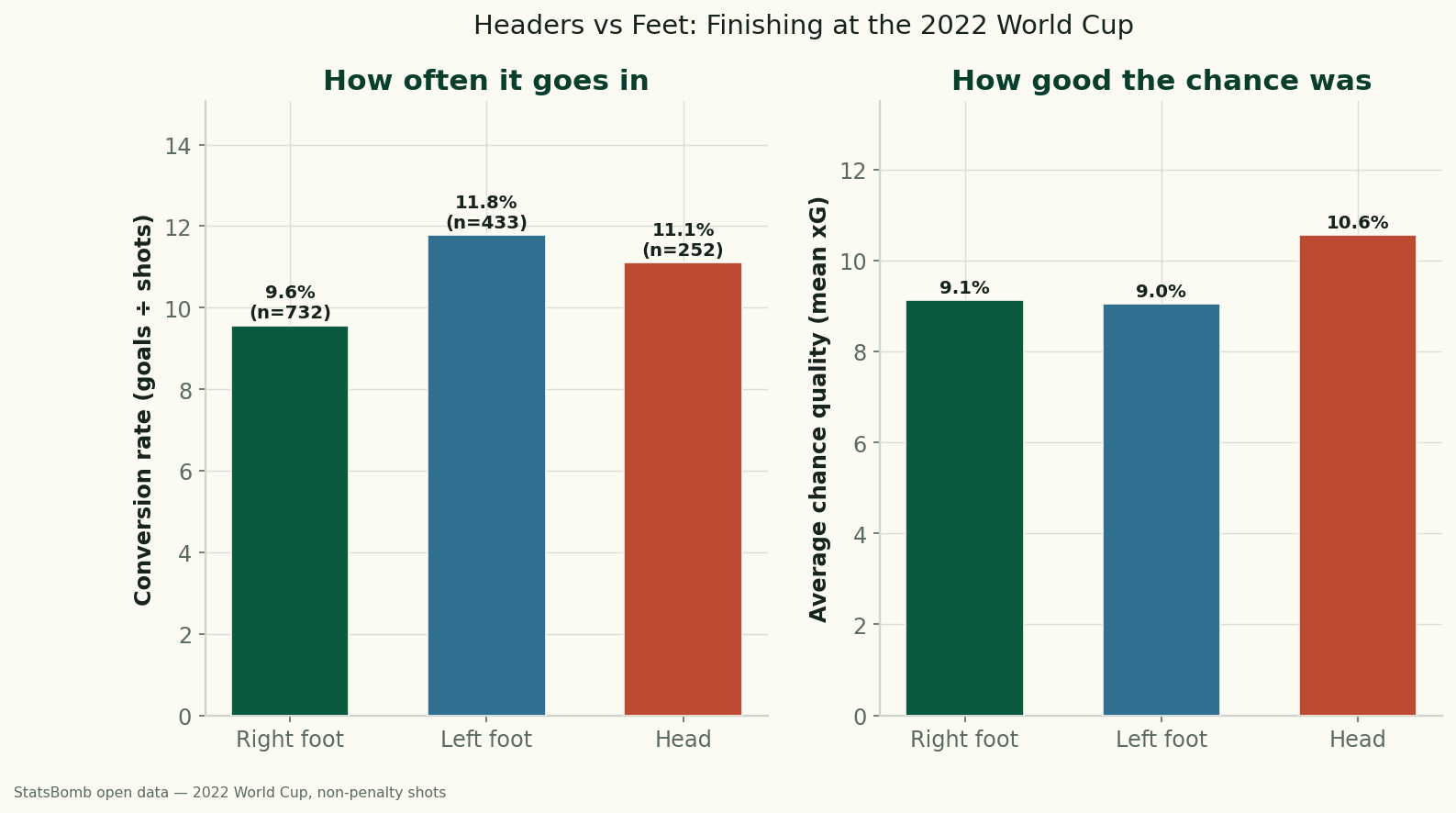
The raw count, and why it lies a little
Start with the two big buckets. Feet — left, right, and a handful of “other” foot strikes — produced 1,178 non-penalty shots and 124 goals, a 10.5% conversion rate. Headers produced 252 shots and 28 goals, an 11.1% conversion rate. Read that twice. The header, the shot everyone tells you to avoid, went in slightly more often than the average foot shot.
But raw conversion is a trap, and it is worth being honest about why. A conversion rate doesn’t know anything about where the shot was taken from. The average header at this World Cup carried a pre-shot expected-goals value of 0.106; the average foot shot, 0.094. Headers, in other words, came from better places — close range, off crosses, off set pieces, inside the six-yard chaos — because to head a ball toward goal you usually have to be near it. The header isn’t converting well because heading is easy. It’s converting well because the chances are juicier to begin with. If you’ve read where World Cup goals are scored from, the proximity story will feel familiar.
Now do it by body part — the order flips
Split the feet apart and the real picture appears. The right foot took 732 shots, scored 70, converted 9.6%, off a mean xG of 0.091. The left foot took 433 shots, scored 51, converted 11.8%, off a mean xG of 0.090. The head took 252 shots, scored 28, converted 11.1%, off a mean xG of 0.106.
Look at the two feet side by side. They shot from chances of almost identical quality — 0.091 and 0.090 mean xG, a rounding error apart. Yet the left foot converted at 11.8% and the right at 9.6%. Same difficulty of chance, very different outcome. That is the kind of gap worth taking seriously, because it can’t be explained away by “the lefties got the better looks.” They didn’t. They just finished.
A worked example: expected goals vs. what actually happened
This is where comparing goals to expected goals earns its keep. Expected goals (xG) is a model’s estimate of how likely an average shot is to score, given its location, angle, body part, and the situation it came from. Conversion tells you what happened; xG tells you what “should” have happened. Subtract one from the other and you get finishing relative to chance quality. (If xG is new to you, we wrote a fuller primer on expected goals explained.)
Walk the left foot through it. 433 shots at a mean xG of 0.090 implies roughly 433 × 0.090 ≈ 39 expected goals. The left foot actually scored 51. That’s about +12 goals above expectation — roughly 30% more than the model thought those chances were worth. Across a single tournament, +12 is enormous.
Now the head. 252 shots at a mean xG of 0.106 implies about 252 × 0.106 ≈ 27 expected goals. Headers scored 28. That’s +1 — essentially bang on the model. Headers met their xG and not a goal more. The right foot, for completeness, scored 70 against roughly 67 expected, a modest +3.
So here is the order, and notice how it inverts the raw-conversion story. By goals-above-expected, feet beat the model — the left foot spectacularly so — while headers merely matched it. The cliché “headers are wasteful” is simply wrong on conversion: headers go in as often as feet. But the more careful claim — that a header is harder than its position suggests — is defensible relative to xG. Put the same quality of chance in front of a finisher’s foot rather than their forehead and, at this tournament, they squeezed more out of it. To be precise, and not overclaim: this is not a “header penalty” in the model. The real story is the left-foot overperformance, plus the unglamorous fact that headers look efficient mainly because they come from better spots.
One more figure worth keeping: headers still accounted for 18.4% of all non-penalty goals (28 of 152). Nearly one World Cup goal in five came off a head. Wasteful is not the word.
Where to pump the brakes
A tournament is 64 matches, and 252 headers is a thin sample to hang strong conclusions on. That +12 for the left foot is the most exciting number in this piece and also the least trustworthy on its own — some real share of it is probably finishing variance, the polite word for luck. A hot two weeks from a few left-footed forwards can move a tournament-level total a long way.
There’s also a model caveat that cuts the other direction. xG is a model, not truth. It may slightly under-rate left-foot strikes, partly through selection: most players’ stronger foot is their preferred one, and they tend to shoot with it from the setups they’ve manufactured to suit it. If the model doesn’t fully capture that, some of the “overperformance” is really the model under-rating the chance. And headers’ higher xG reflects proximity, not ease — the model already knows headers come from close, which is exactly why their xG is high and their goals-above-expected is flat. Finally, this is World Cup level. Elite finishers, elite delivery; don’t assume the same edges hold in a Tuesday-night league game.
None of that erases the finding. It just sizes it: headers convert as well as feet because they come from better positions, and the left foot was the most clinical body part at the 2022 World Cup relative to the chances it had. If you want to see this with your own eyes, the player-level xG overperformance breakdown and the article on where World Cup players aim both pull at the same thread, and the aerial side gets its own treatment in aerial duels and heading data. You can also poke at individual shots in the interactive shot-map explorer on the World Cup hub.
How to reproduce this
It’s a short recipe. For each shot in data_layer/wc2022_shots.json, group by body_part, then within each group compute conversion as goals divided by shots and chance quality as the mean of the pre-shot xG values, excluding any penalty. Roll left, right, and other foot together to get the “feet” bucket; keep the head separate. Multiply each group’s shot count by its mean xG to get expected goals, and compare against actual goals for the over/under-performance figures above. The whole thing is recomputed end to end by charts/chart_wc2022_body_part.py, which also draws the two-panel figure at the top.
Sources, notes & further reading
- The data: StatsBomb open data — the free, public event data for all 64 matches of the 2022 World Cup, plus the reproduction script
charts/chart_wc2022_body_part.py. - Related: who overperformed xG at the 2022 World Cup and expected goals explained for the model behind every figure here.
- Data provided by StatsBomb.
More from Data Deep-Dives
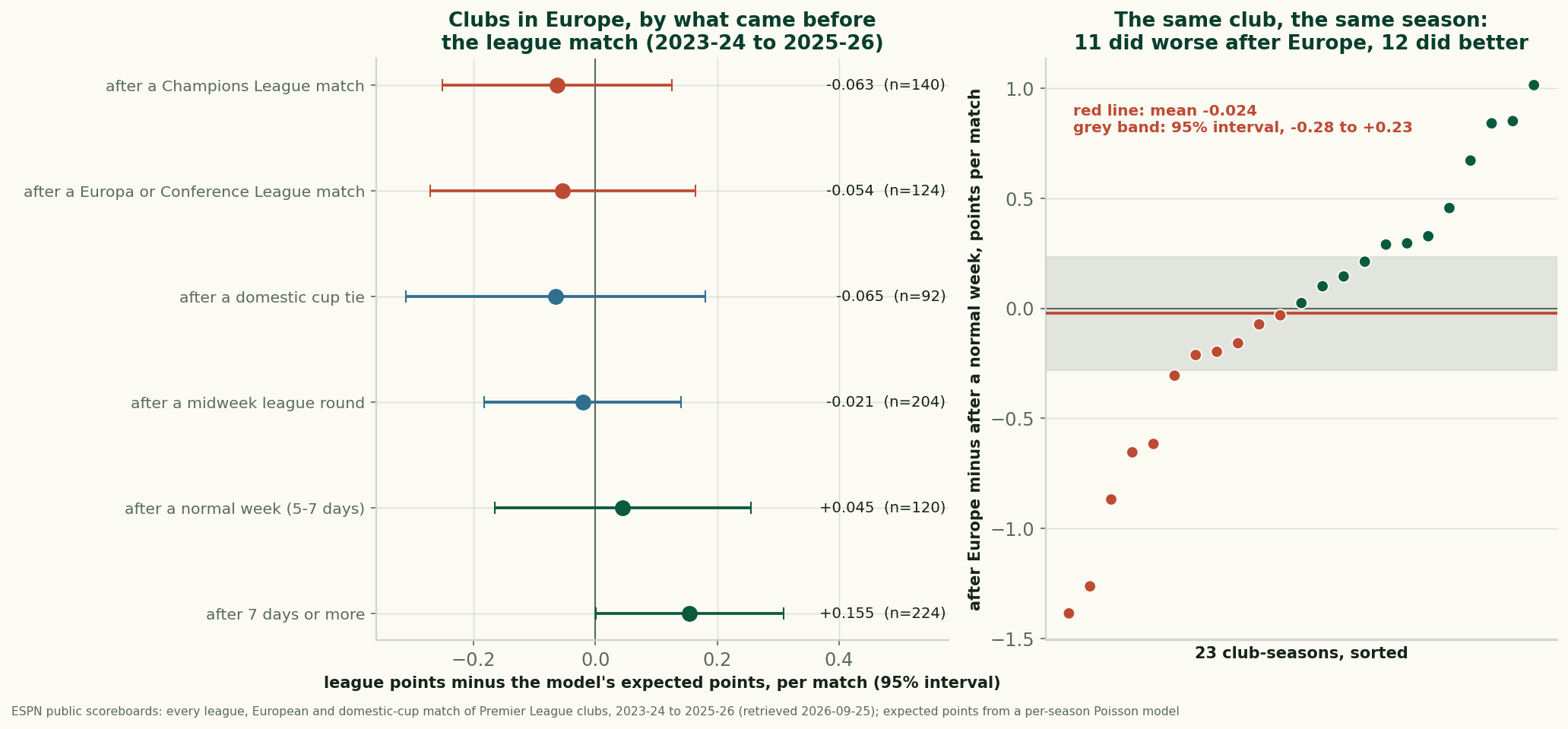
Does Europe Cost English Clubs at the Weekend? Three Seasons Can't Find It
After a European night, English clubs took 1.56 league points a match against 1.62 expected. Within the same club and season the gap is -0.024: not measurable.
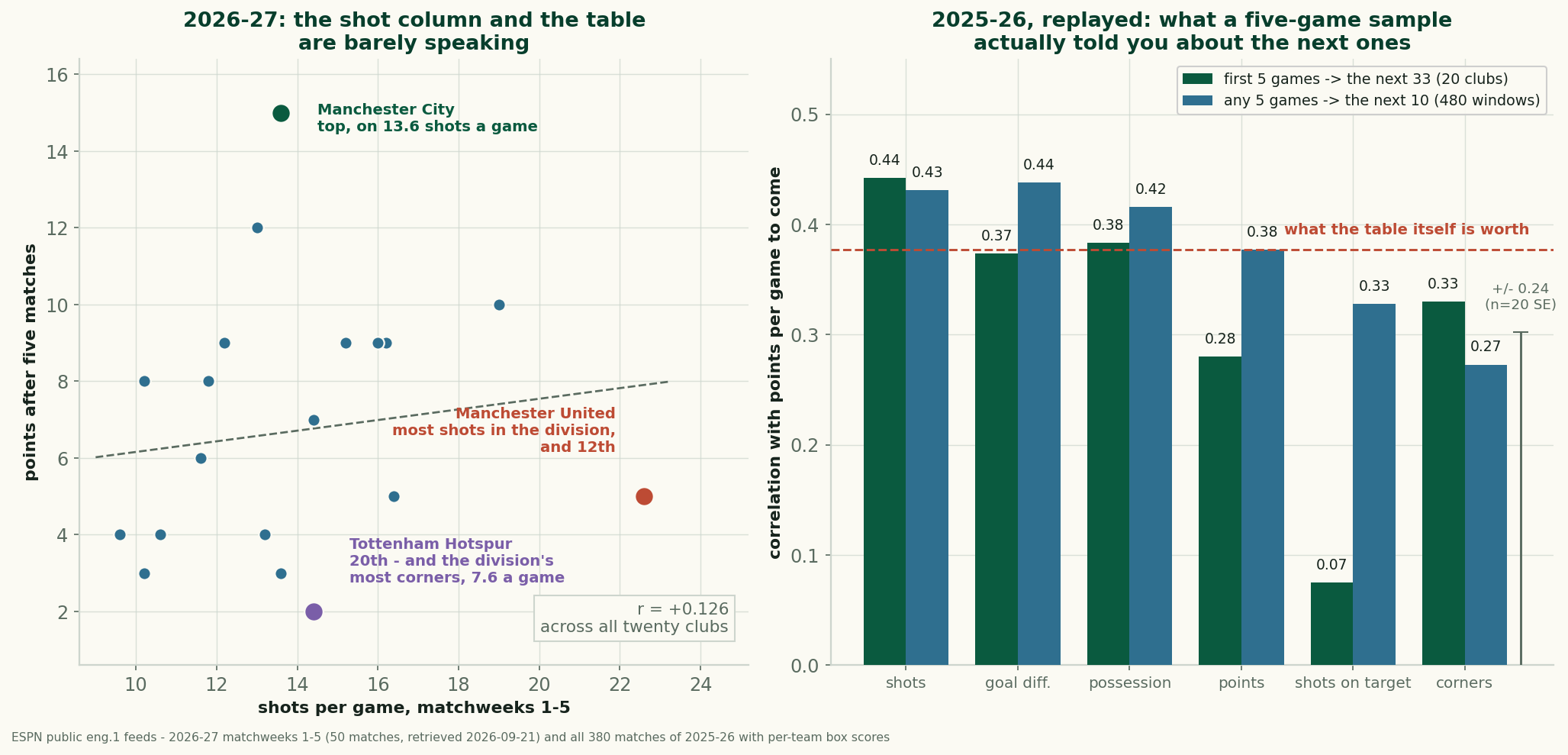
Manchester United Lead the League in Shots and Sit Twelfth
United take 22.6 shots a game and have 5 points. Across 2025-26, a club's five-game shot count predicted its next results better than its points did.
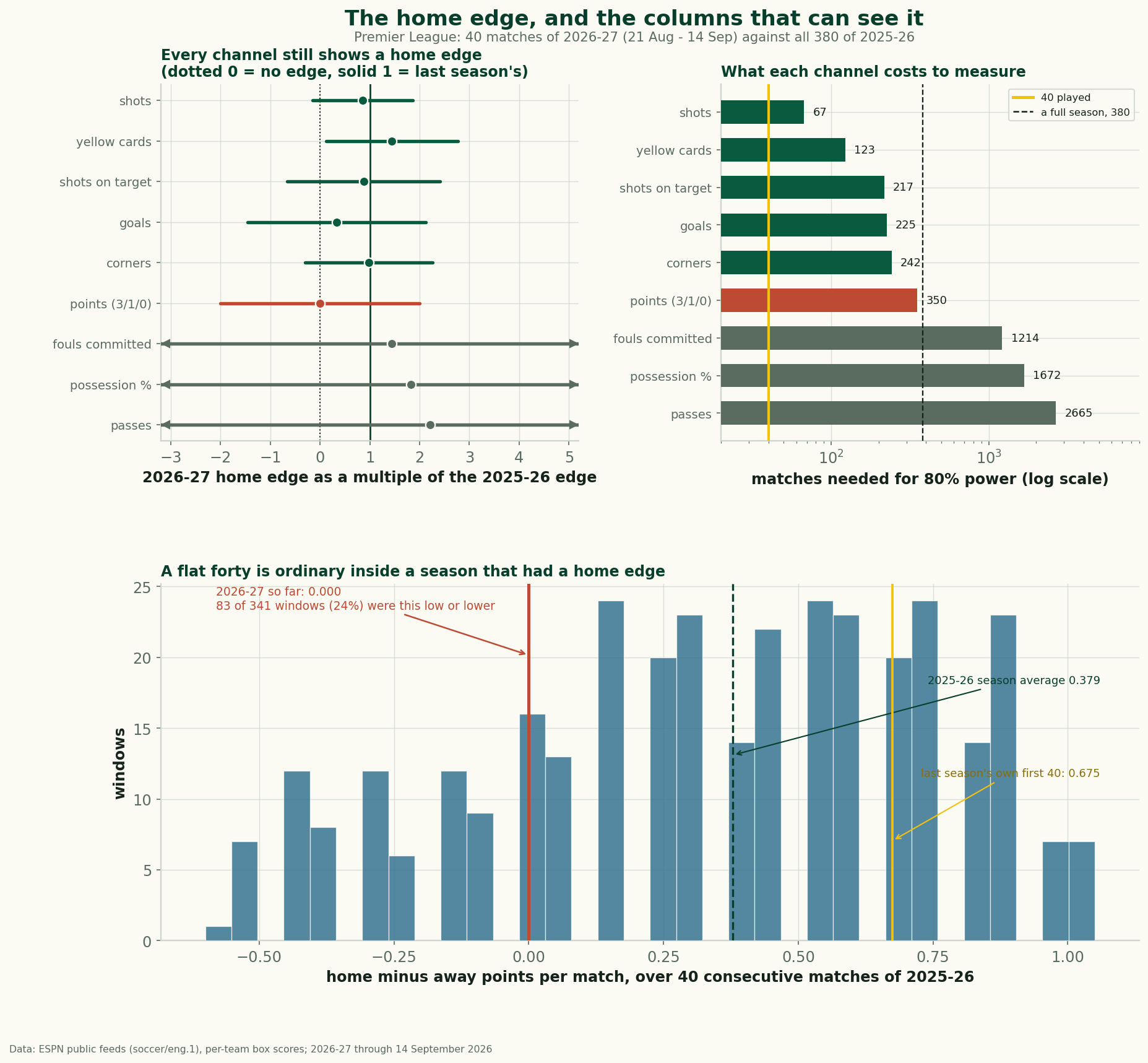
Home Advantage Didn't Die. The Results Column Can't See It
Home and away split the first 40 matches of 2026-27 evenly, yet the shot, corner and card columns keep the home edge. Plus a decade of home-advantage data.