Possession Value and VAEP Explained: Scoring Every Action on the Pitch
How to put a number on a pass, a carry, even a tackle.
Expected goals values shots, and only shots. Expected assists values the one pass before a shot, and only that pass. But a football match is thousands of actions, and the overwhelming majority of them are neither shots nor the pass before a shot — the recovery in your own half, the carry that breaks a line, the tackle that ends the other team’s best move of the game. None of those touch the scoresheet, and none of them touch xG either. Possession-value models exist to put a number on all of them.
What xG and xA leave on the table
The expected-goals family is the best thing to happen to football measurement in a generation, but it has a hard boundary: it only ever speaks about chances. A shot gets an xG value; the action that created it gets an xA value; everything else gets nothing. That is fine if all you want to know is who finishes and who teed up the finish, but it leaves enormous swathes of the game unmeasured.
Consider a holding midfielder who, twice a game, intercepts a pass at the edge of his own box and immediately drives forty yards before laying the ball off. Those moves might end in a shot three passes later, or they might not. Under xG and xA, that midfielder’s most valuable contributions — the interception, the carry, the release — are simply invisible unless he happens to be the last man before the shot. The same blind spot hides the ball-playing centre-back, the press-resistant deep-lying playmaker, and the defender whose timing snuffs out danger before it becomes a chance. The box score has no column for "stopped a goal that never happened."
The fix is to stop measuring only the end of moves and start measuring every action by what it does to the odds.
The core idea: value = change in scoring probability
Possession-value models — you will also see them called on-ball value (OBV) or expected possession value (EPV) — share one simple premise. At any moment, the team in possession has some probability of scoring in the near future and some probability of conceding. Every action the players take nudges those probabilities up or down. The value of an action is exactly that nudge.
A progressive pass that moves the ball from your own third into the opponent’s half raises your scoring probability a little, so it earns a small positive value. A through-ball that splits the last line and sets a striker free raises it a lot, so it earns more. A carry into the box, a pass that retains possession under pressure, a clearance that ends a dangerous attack — each is scored by how much it shifted the odds. Give the ball away cheaply in your own half and you have handed the opposition a better position, so the action is scored negatively.
This is the same logic that drives expected threat (xT), which assigns every pitch location a scoring probability and credits passes and carries with the difference between where the ball ended and where it began. Possession value generalises that idea: instead of valuing only ball location, the richest models look at the full context — where the ball is, how the action moved it, what kind of action it was, even how much time has passed — and ask how the odds changed.
VAEP: valuing actions by estimating probabilities
The best-known public framework for this is VAEP, which stands for Valuing Actions by Estimating Probabilities. Its central refinement over a location-only model is that it scores every action on two probabilities, not one: the chance the team scores within the next few actions, and the chance it concedes within the next few actions.
The value of an action is the change in the scoring probability minus the change in the conceding probability. That second term is what makes VAEP fair to defenders and to risk. A flashy pass that splits two players but, if intercepted, would leave your defence horribly exposed is not purely good — it raises your scoring odds but also your conceding odds, and VAEP nets the two. A clean interception that ends an opposition attack lowers your conceding probability, so it scores positively even though no shot was ever taken and no progressive pass was ever made.
For each action, a model estimates two things from a large history of matches: Pscore — the probability the team in possession scores within the next k actions — and Pconcede — the probability it concedes within the next k actions. The value of the action is (ΔPscore) − (ΔPconcede): how much it raised the scoring odds, minus how much it raised the conceding odds. Sum every action a player performs and you have their total VAEP contribution — offensive value, defensive value, and the net.
Because every action gets a number, you can total a player’s VAEP over a match or a season and split it into the part that came from attacking actions and the part that came from defensive ones. That single property — a common currency for a tackle and a through-ball — is what makes possession value so useful for comparing players whose jobs look nothing alike.
An illustrative action-by-action move
The numbers below are invented round figures, chosen only to show how the credit lands — they are not from any real match. Imagine a possession that runs through four actions and ends in a chance worth 0.18 xG.
| Action | P(score) before | P(score) after | Value |
|---|---|---|---|
| CB intercepts in own third | 0.01 | 0.02 | +0.01 |
| Midfielder carries 30m upfield | 0.02 | 0.05 | +0.03 |
| Through-ball splits the last line | 0.05 | 0.14 | +0.09 |
| Striker shoots (0.18 xG chance) | 0.14 | — | — |
Under xA, only the through-ball would be credited, because it was the pass immediately before the shot. Under xG, only the shot counts. Possession value pays the interception, the carry, and the through-ball each in proportion to how much they improved the odds — and if the interception had also cut out a dangerous opposition attack, VAEP would add the defensive credit for the conceding probability it pushed down. The progressive actions described in progressive passes and carries are exactly the kind of contributions this rewards, but possession value goes further by attaching a precise scoring-probability number to each one rather than just counting it.
How it relates to xT and xGChain
It helps to see possession value as the most general member of a family you already know. Expected threat is a possession-value model that uses ball location as its only input — elegant, transparent, and easy to compute, but blind to anything location does not capture. VAEP and on-ball value are richer models that fold in the type of action and its context, and crucially add the conceding side so defensive actions get scored too.
xGChain and xGBuildup attack the same problem — crediting players who build moves rather than finish them — but with a blunter instrument: they hand every player in a shot-ending possession the full xG of the chance, regardless of whether their individual touch helped or hurt. Possession value is finer-grained: instead of splitting one chance’s xG evenly across everyone who touched the ball, it asks what each specific action did to the odds, so a meaningless square pass and a line-breaking carry in the same move are not paid the same.
The caveats — read these before you rank anyone
Possession value is powerful, but it is more model-dependent than xG, and you should treat its outputs with more caution. Three things in particular.
First, it is only as good as the model and the data behind it. Two providers’ possession-value numbers are not directly comparable, because they trained different models on different event data with different definitions of "the next few actions." A player’s VAEP per 90 means something only relative to others computed the same way.
Second, it needs rich event data. A credible model wants carries, pressures, and accurate locations, not just passes and shots. On thin data it degrades quietly — it will still produce numbers, but those numbers lean harder on the model’s assumptions than on what actually happened.
Third, it can over-credit volume. A player who simply touches the ball constantly accumulates value almost mechanically, just as raw xGChain rewards being on a high-possession team. The standard guardrails apply: read the numbers per 90, think in possession-adjusted terms, and never let a single composite number stand in for watching the player. Used that way — as a diagnostic that points you toward contributions the box score hides, not as a final verdict — possession value is the closest the public game has come to a single currency for everything that happens on the ball.
Where these numbers come from
- StatsBomb — research and methodology on on-ball value and possession-value modelling.
- StatsBomb open data — event-level data with the carries, pressures, and locations a possession-value model needs.
- FBref — progression and shot-creation data that complement a possession-value view.
- Karun Singh’s blog — the original public write-up of expected threat, the simplest possession-value model to learn from.
More from Stat Explainers
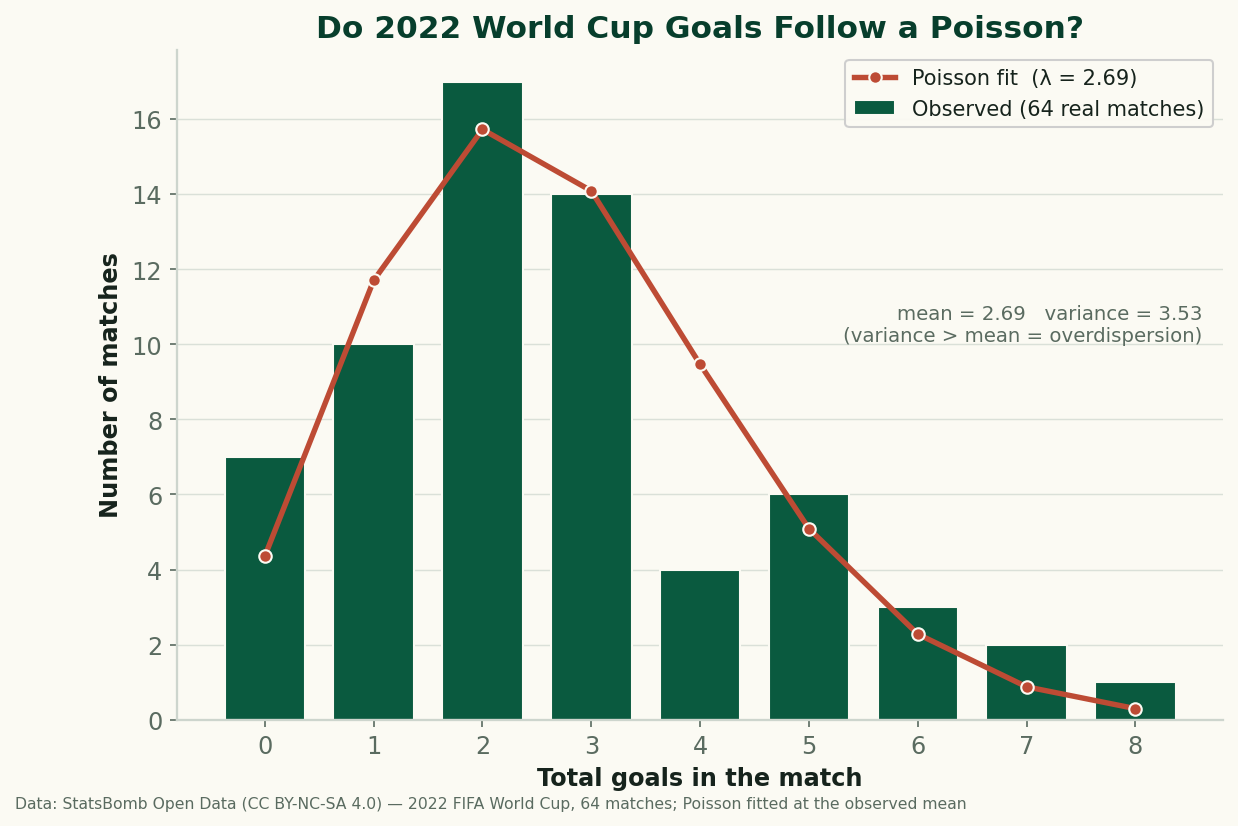
Do Football Goals Follow a Poisson? Testing the Standard Model on All 64 Games of 2022
Every scoreline prediction in football rests on the Poisson. We fit it to all 64 games of 2022 — it gets the shape right, but real goals are overdispersed.
Aerial Duels and Heading Data: Reading Win Rate Without Getting Fooled by Volume
Aerial-duel win percentage, why raw counts mislead, and where aerial dominance actually matters — set pieces, target men, and defending crosses.
Expected Points (xPts): Turning Shot-Level xG Into a Fairer Table
Expected points (xPts) simulates a match from its shot-level xG to get win, draw and loss odds — points that reward chances created, not goals that went in.