The Volley Is Not the Wasteful Shot You Were Told
Volleys converted higher than settled shots, because a volley is evidence the ball reached a good spot. The real spectacle shots — overheads, backheels — produced nothing.
There is a coaching cliché that a good striker "takes a touch to settle it," the implication being that the volley, the half-volley, the ball smashed on the drop, is the desperate option — low-percentage, hit in hope. It is a widely held view. Counting every open-play foot shot at the 2022 World Cup, split by how the ball was struck, says something more interesting than the cliché. Volleys converted at 15.2% and half-volleys at 10.4%. Settled "normal" shots — ball on the ground, planted and struck — converted at just 9.8%. The improvised shot was, if anything, the better shot.
Sourcing. All figures are computed from StatsBomb's free 2022 World Cup data, all 64 matches. We use the 1,178 open-play shots taken with the feet (penalties excluded, and headers set aside, since headers versus feet is its own question). Each shot carries a StatsBomb technique label. Nothing here is remembered or invented.
The exhibit: conversion by how the ball was struck
| Technique | Shots | Goals | Conversion | xG per shot | Goals − xG |
|---|---|---|---|---|---|
| Normal (settled) | 849 | 83 | 9.8% | 0.086 | +9.9 |
| Half volley | 212 | 22 | 10.4% | 0.110 | −1.4 |
| Volley | 92 | 14 | 15.2% | 0.118 | +3.2 |
| Lob | 13 | 5 | 38.5% | 0.251 | +1.7 |
| Overhead kick | 7 | 0 | 0.0% | 0.057 | −0.4 |
| Backheel | 5 | 0 | 0.0% | 0.068 | −0.3 |
Real values from StatsBomb Open Data, 2022 World Cup, 1,178 open-play foot shots (headers and penalties excluded). "Goals − xG" is a group's total goals minus its summed expected goals. Data provided by StatsBomb.
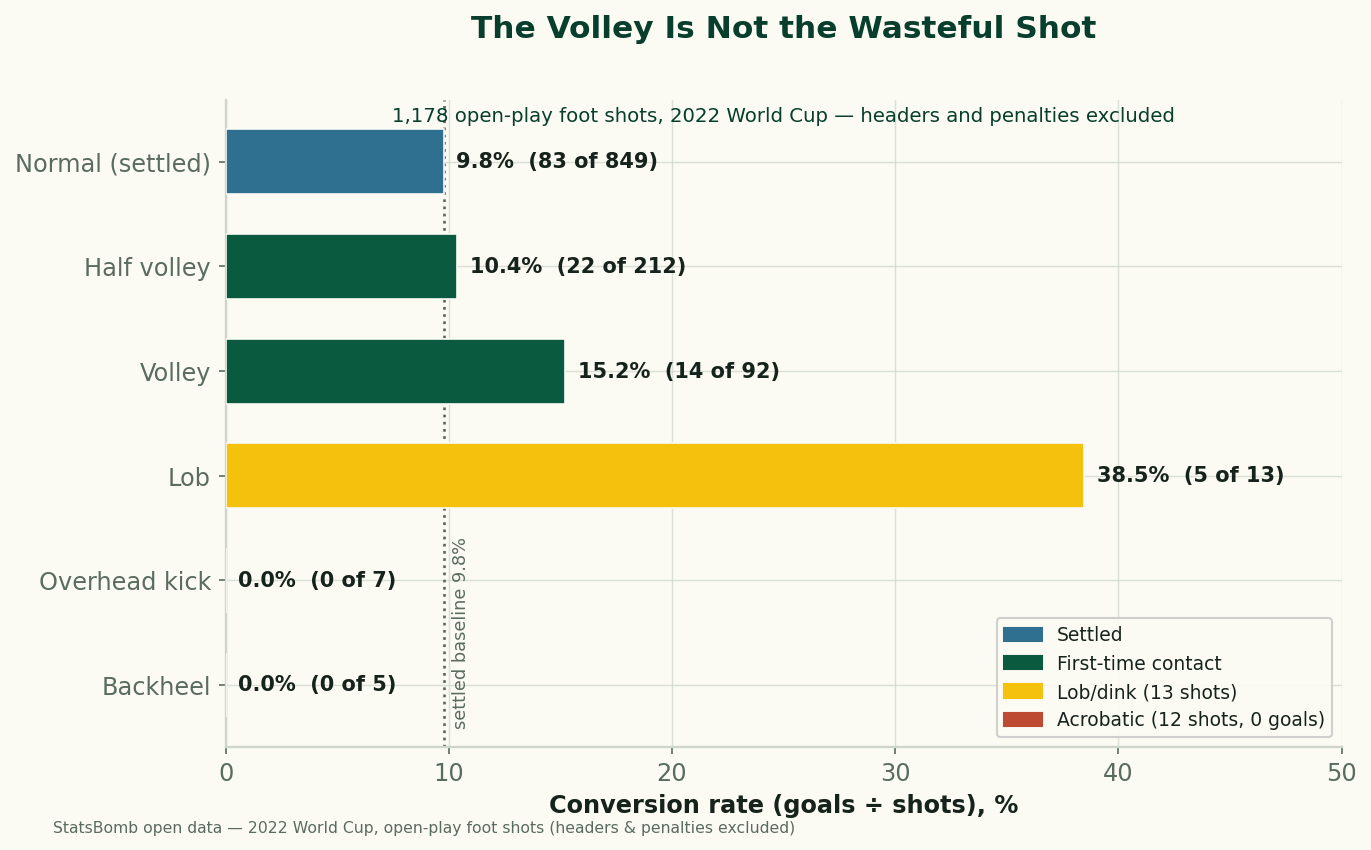
The finding: technique is really a proxy for the situation
Group the first-time contacts together — volleys and half-volleys — and you get 304 shots converted at 11.8%, against 9.8% for the 849 settled shots. The gap is not enormous, but it points the wrong way for the folk wisdom. Why would a harder skill produce a better result?
Because the technique label is not really telling you about difficulty. It is telling you about how the ball arrived. A volley happens because a cross, a cutback, or a knockdown dropped to a striker in the box — a live, moving ball in a dangerous area. The reason you are volleying is that the situation did not give you time to take a touch, and situations like that tend to be good ones: you are already inside the area with the ball coming to you. A settled shot, by contrast, includes every hopeful drive from 25 yards where the player had all day precisely because nobody was worried about him. The higher xG per shot on volleys (0.118) and half-volleys (0.110) versus settled shots (0.086) confirms it — the model already knows first-time chances tend to come from better places. The technique is a symptom of the chance, not a tax on it.
The spectacle shots score nothing
The bottom of the table is the honest counterweight. The overhead kick and the backheel — the two shots that make a highlight reel — combined for 12 attempts and zero goals across the entire tournament. These are the genuinely low-percentage acts, attempted when the ball is behind you or over your head and orthodox contact is impossible. They exist because occasionally there is no other option, and once in a great while one flies in and gets replayed for a decade, which is exactly why we overrate them. The 2022 World Cup produced not a single open-play goal from either. If any technique deserves the "wasteful" label, it is these — not the volley.
The real finesse finish is the one almost nobody talks about: the lob or dink, 13 attempts and 5 goals, a 38.5% conversion. That is a chip over an advancing keeper, attempted only when a striker is clean through and reads the situation early. It is rare, it is deliberate, and it works — but the sample is tiny, and we would not build a theory on 13 shots. It is a footnote, not a headline.
A note on that "+9.9"
The settled-shot row overperformed its expected goals by nearly ten — 83 goals on about 73 xG. That looks dramatic until you remember that the 2022 World Cup as a whole finished a little hot, scoring 152 open-play goals on 137.9 xG, and settled shots are the largest bucket, so they inherit most of that tournament-wide overperformance. It is not evidence that planting-and-striking is a magic skill; it is mostly the same finishing variance that shows up when you ask who beat their xG. Spread across 849 shots, a +9.9 is a rounding-error edge per attempt. Read it as "settled shots finished roughly on model, maybe a touch above," not as a discovery.
The honest caveats
- Small samples at the bottom. Volleys (92), lobs (13), overheads (7) and backheels (5) are thin. The 0% for overheads and backheels is real but would move with a few more matches; treat the exotic rows as directional, not precise.
- Correlation, not a controlled test. Volleys convert better because they come from better places, not because volleying is easy. Hand a striker the choice to take a touch and he will — the volley is forced by circumstance, and the circumstance is what is good.
- The xG model already prices technique in. StatsBomb's model uses shot type as a feature, so the "xG per shot" column is not an independent yardstick — it partly encodes the same information as the technique label.
- One tournament, one model. Another xG model or another World Cup would shift the exact conversion rates. The direction — first-time contact is not the wasteful shot — is the durable part.
The takeaway
The cliché has it backwards. At the 2022 World Cup the improvised, first-time shot converted better than the settled one, not because volleying is easy but because a volley is a receipt: it proves the ball reached a good position with a defender too slow to stop the strike. The shots that truly wasted chances were the acrobatic ones — overheads and backheels, twelve attempts and nothing to show. As with so much in this data, the technique is downstream of the situation, and the situation is what you should be watching. For where these dangerous first-time balls come from, the cutback is the pass that creates more of them than any other.
Reproduce it
From data_layer/wc2022_shots.json, keep open-play shots and drop headers and penalties (the handful of chest- and knee-type shots StatsBomb files under “Other” stay in — all of them are technique Normal), then group by the technique field and, per group, count shots and goals and sum the xg. Conversion is goals over shots; the last column is goals minus summed xG. Nothing hand-entered: the build renders this page offline from that bundled file.
Sources, notes & further reading
- Shot, technique & xG data: StatsBomb open data (free public dataset; attribution required), FIFA World Cup 2022, all 64 matches, bundled as
data_layer/wc2022_shots.json. Data provided by StatsBomb. - Companion: headers versus feet and who beat their xG.
- Background: expected goals explained · the cutback, the most dangerous assist.
More from Data Deep-Dives
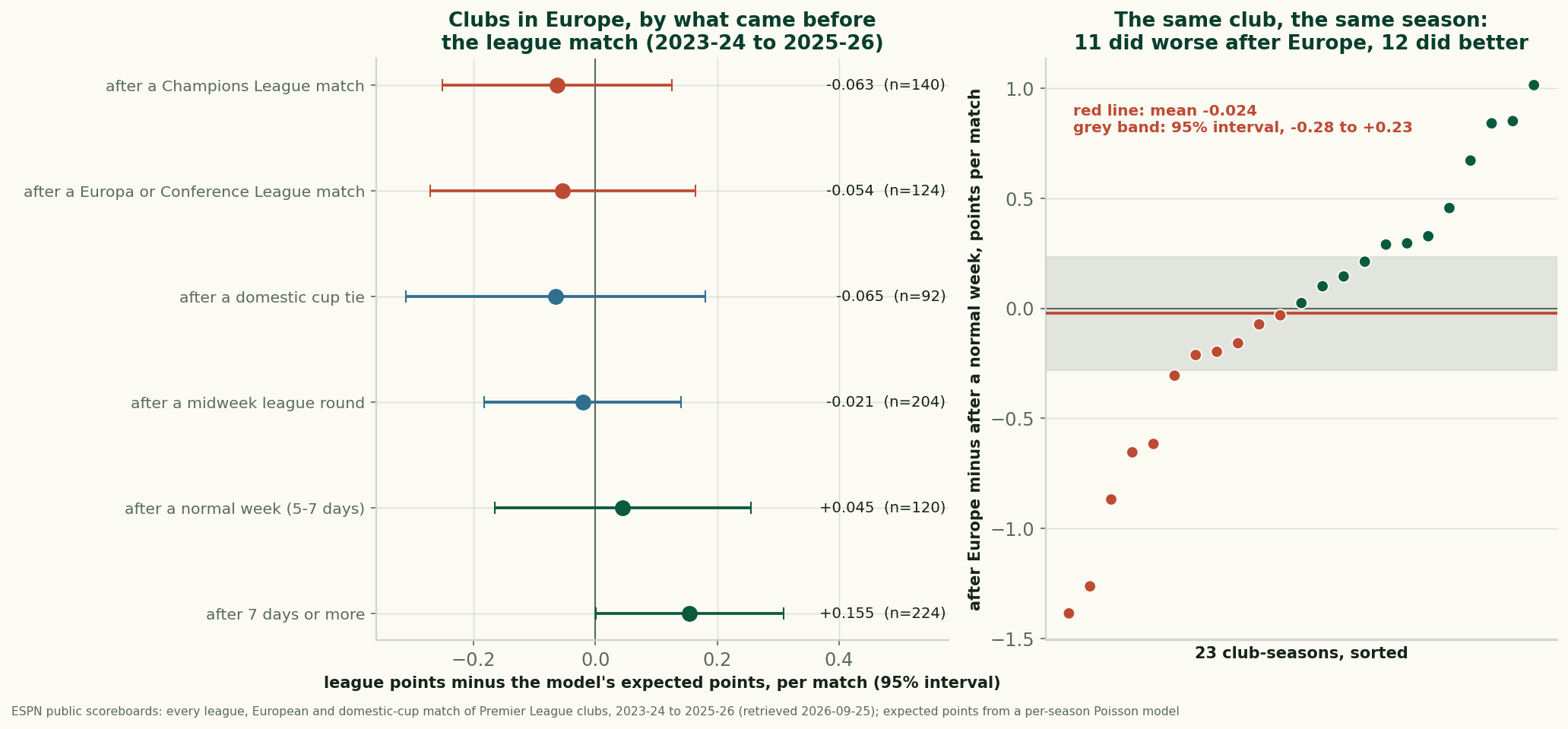
Does Europe Cost English Clubs at the Weekend? Three Seasons Can't Find It
After a European night, English clubs took 1.56 league points a match against 1.62 expected. Within the same club and season the gap is -0.024: not measurable.
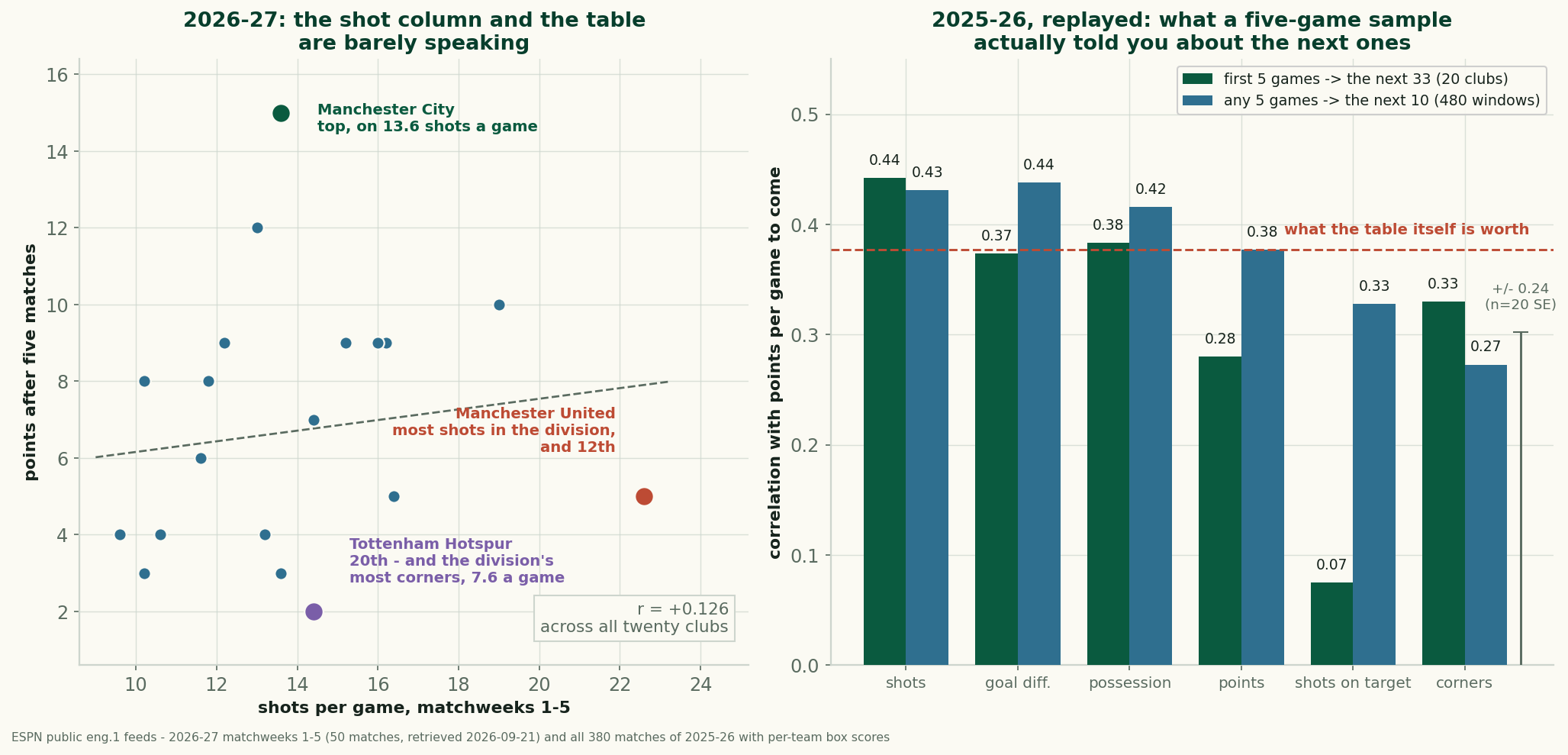
Manchester United Lead the League in Shots and Sit Twelfth
United take 22.6 shots a game and have 5 points. Across 2025-26, a club's five-game shot count predicted its next results better than its points did.
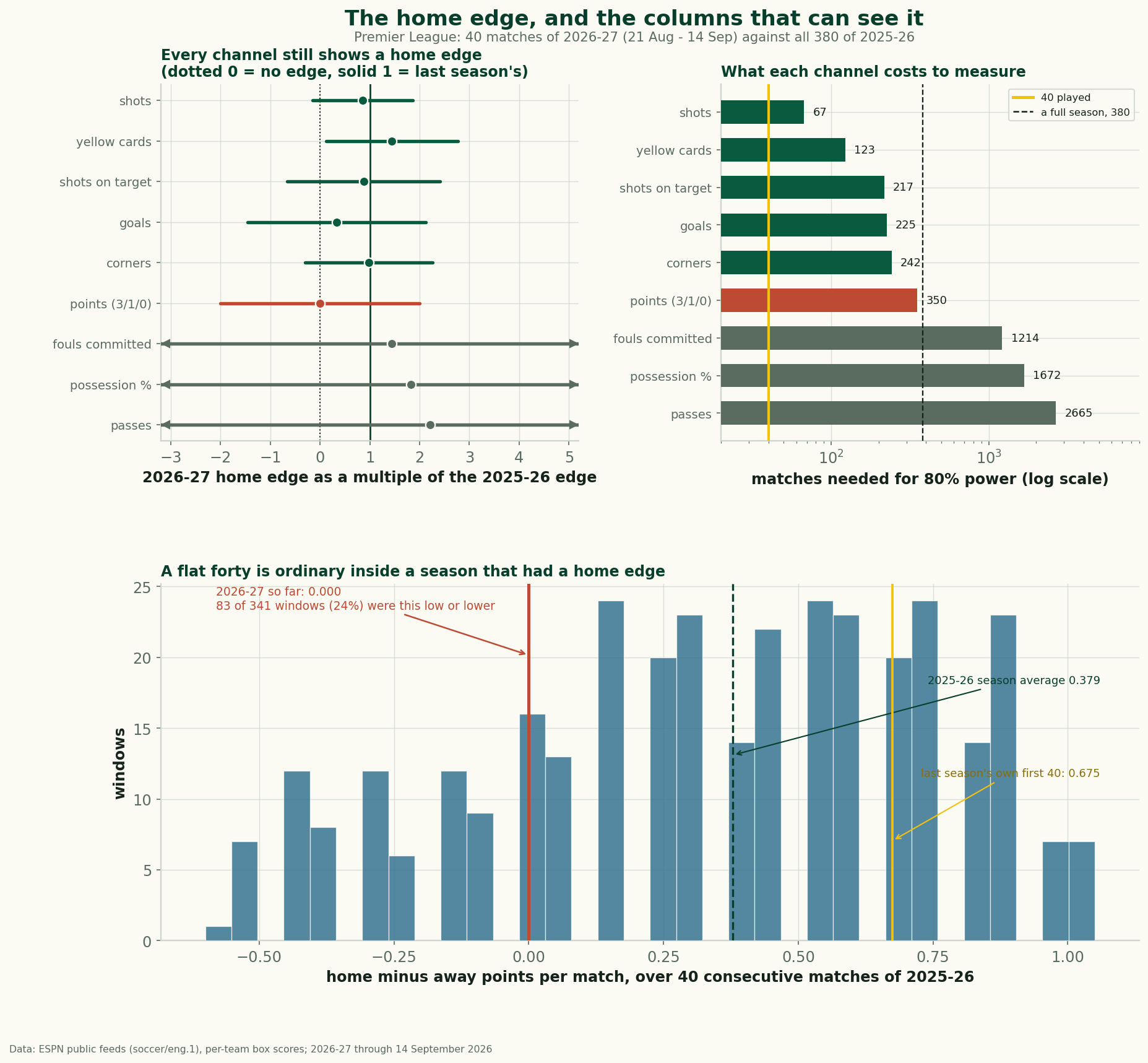
Home Advantage Didn't Die. The Results Column Can't See It
Home and away split the first 40 matches of 2026-27 evenly, yet the shot, corner and card columns keep the home edge. Plus a decade of home-advantage data.